
Organizations across the Caribbean face a persistent challenge. They invest significant resources in crafting comprehensive strategic plans, secure stakeholder buy-in, and gain approval from boards and cabinets. Then the plans stall. Research shows that approximately 76% of well-informed strategies fail during execution (Carucci, 2017). This failure occurs not because the strategies are weak, but because organizations lack the systems, capacity, and coordination required to translate strategic documents into operational reality. The gap between strategy and implementation represents the single most expensive inefficiency in Caribbean development work today.
Systematic reviews of peer-reviewed literature identify consistent barriers to strategy implementation across public sector organizations (Vigfússon et al., 2021; Girma, 2022). These barriers include fragmented leadership structures, inadequate resource allocation systems, weak coordination mechanisms across organizational units, and insufficient performance monitoring frameworks. Caribbean Small Island Developing States face additional structural challenges. Limited human resource capacity, competing urgent priorities, and external shocks like hurricanes and economic volatility create an environment where even well-designed strategies struggle to gain traction. A study of public sector organizations found that those with strong organizational capabilities (including workforce skills and management systems) achieved significantly better implementation outcomes, yet many organizations rated their internal processes and incentive structures as merely adequate (Mwanza et al., 2025). The Caribbean development sector mirrors these global patterns. Organizations formulate ambitious climate resilience frameworks, food security strategies, and digital transformation roadmaps. Consultants deliver polished documents. Cabinets approve budgets. Then progress stalls because no one established the implementation architecture: the coordination mechanisms, monitoring systems, risk protocols, and capacity-building programs required to execute complex multi-year initiatives in resource-constrained environments.
The literature identifies several implementation enablers that distinguish successful organizations from those that struggle (Cândido & Santos, 2019). First, integrated leadership frameworks that align senior executives with middle management prove essential. Strategy cannot cascade through an organization when mid-level managers lack clarity on their role in execution. Second, organizations need real-time monitoring systems that surface implementation challenges early. Traditional annual reporting cycles allow problems to compound for months before becoming visible. Third, organizations require flexible structures that enable rapid decision-making when external conditions change. Caribbean SIDS cannot afford rigid bureaucratic processes when hurricanes, commodity price shocks, or pandemic disruptions demand immediate strategic adaptation. Fourth, successful implementation requires systematic attention to organizational culture and employee engagement. Research demonstrates that organizations with supportive cultures that clearly communicate strategy and explain the logic behind strategic choices achieve dramatically higher implementation success rates (Kaplan & Norton, 1996, as cited in multiple implementation studies). Finally, modern performance measurement frameworks that track leading indicators rather than only lagging financial metrics enable organizations to manage strategy execution proactively rather than reactively.
Uwàmìto Consulting specializes in building the bridge between strategy and implementation. Over the past six years, we have managed more than 20 development consultancies across the Caribbean, supporting national governments, multilateral donors, regional bodies, and civil society organizations. Our work demonstrates consistent patterns. When we design strategic plans, we simultaneously build the implementation architecture: project management systems, monitoring dashboards, risk registers, and stakeholder coordination protocols. When we support entities to refine the grant and financing applications, we do not stop at securing funding approval. We establish project management offices, train government counterparts in results-based management, and create knowledge management systems that capture lessons for future initiatives. When we developed a community-led monitoring system for HIV services, we delivered not just a framework document but a fully operational system with trained field officers, data collection tools, secure databases, and reporting templates that organizations continue to use today. This approach reflects our understanding that Caribbean development challenges demand integrated solutions. Strategy documents alone change nothing. Implementation without strategy creates chaos. Organizations need consultants who can design bankable strategies and simultaneously build the capacity and systems required to execute them.
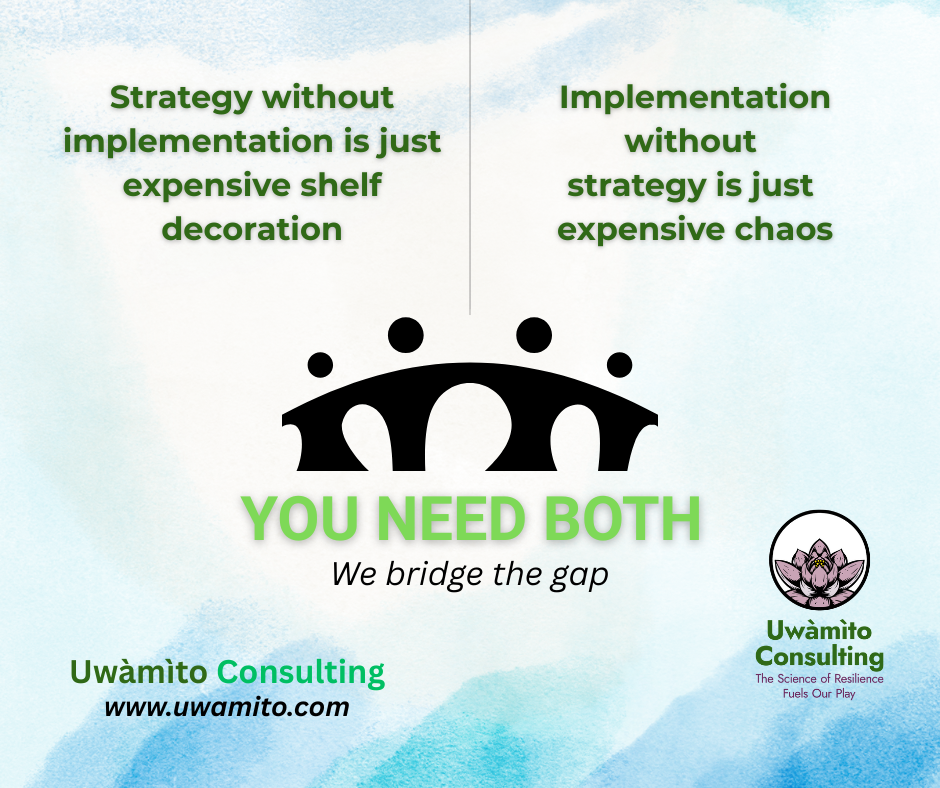
The graphic we created illustrates this reality simply. Strategy without implementation becomes expensive shelf decoration. Implementation without strategy becomes expensive chaos. You need both, and you need the expertise to bridge them. Uwàmìto Consulting offers Caribbean governments and development organizations what they actually require: consultants who combine deep technical expertise with practical implementation capacity. We do not deliver reports and disappear. We embed systems, train teams, establish coordination mechanisms, and ensure that strategic investments generate measurable results. When you engage Uwàmìto, you partner with consultants who have managed HIV prevention programs reaching 5,000+ people, reviewed national suicide surveillance systems adopted by Ministries of Health, and built strategic frameworks that organizations use daily for fundraising and program development. Our track record demonstrates what becomes possible when strategy and implementation function as integrated disciplines rather than separate activities. This is how development consulting should work. This is how Caribbean organizations can finally close the strategy-implementation gap.
Ready to close your strategy-implementation gap? Contact Uwàmìto Consulting for a confidential consultation. We begin with a Resilience Audit to identify your organization's specific implementation barriers, then design integrated solutions that deliver measurable results. Visit www.uwamito.com or email melliot@uwamito.com to start the conversation. You can call or WhatsApp: 1.868.756.9981
Refrences:
Cândido, C. J. F., & Santos, S. P. (2019). Implementation obstacles and strategy implementation failure. Baltic Journal of Management, 14(1), 39-57. https://doi.org/10.1108/BJM-11-2017-0350
Carucci, R. (2017, November 13). Executives fail to execute strategy because they're too internally focused. Harvard Business Review. https://hbr.org/2017/11/executives-fail-to-execute-strategy-because-theyre-too-internally-focused
Girma, B. G. (2022). Pitfalls on strategy execution of an organization: A literature review. Financial Metrics in Business, 3(2), 227-237. https://doi.org/10.25082/FMB.2022.02.004
Mwanza, M., et al. (2025). The role of strategy implementation practices on performance of the public sector organisations. Africa's Public Service Delivery & Performance Review, 13(1). https://doi.org/10.4102/apsdpr.v13i1.891
Vigfússon, K., Jóhannsdóttir, L., & Ólafsson, S. (2021). Obstacles to strategy implementation and success factors: A review of empirical literature. Strategic Management, 26(2), 12-30. https://doi.org/10.5937/StraMan2102012V