The 73% Problem: What Caribbean Development Projects Get Wrong in the Preparation Phase

Why seven out of ten Caribbean infrastructure projects face delays: how Implementation Science offers a systematic solution

The Pattern We Keep Repeating

A road rehabilitation project in Jamaica takes three years longer than planned. A water infrastructure initiative in Saint Lucia stalls during procurement. A climate resilience project in Dominica struggles with scope changes and budget revisions. Different islands, different sectors, same story: Caribbean development projects consistently take far longer to deliver than originally planned.

The Caribbean Development Bank confronted this reality directly at their June 2025 Annual Meeting in Brasília. Their baseline assessment of 35 projects across ten Caribbean countries revealed what practitioners already knew from experience: persistent procurement delays, institutional capacity constraints, procedural inefficiencies, and oversight issues hamper project implementation across the region. But the assessment went further, identifying fragmented stakeholder coordination, disjointed communication, limited engagement during implementation, and insufficient on-the-ground readiness as factors negatively affecting project outcomes.

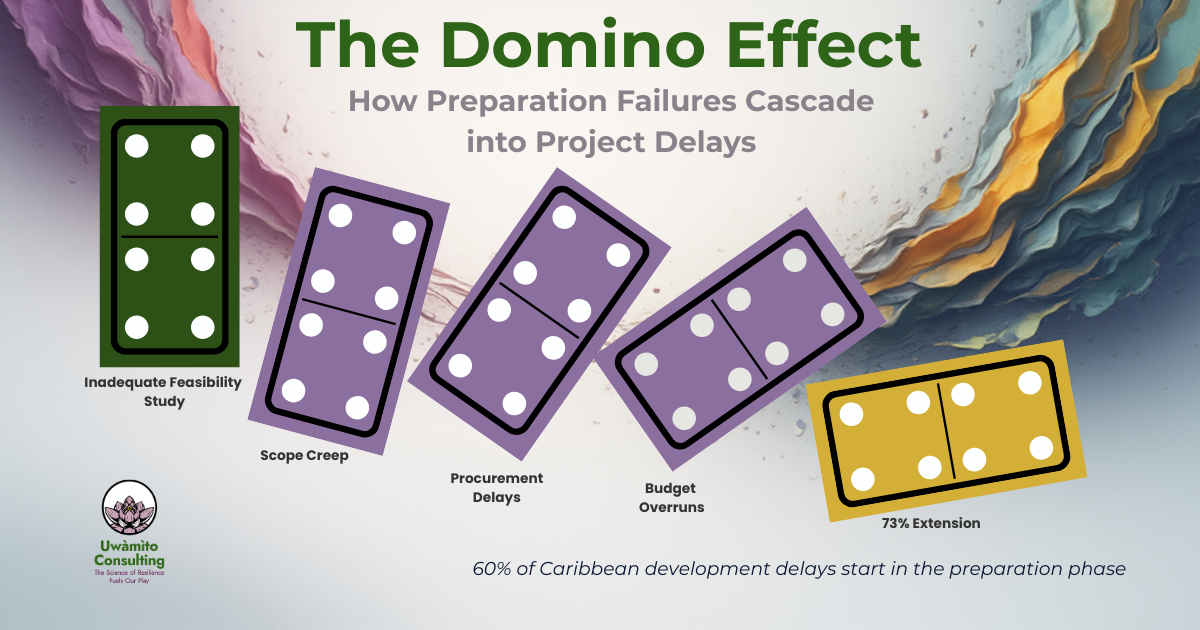
This is not a Caribbean-specific problem. A global analysis by the CoST Infrastructure Transparency Initiative examined 480 projects across three continents and found that 70% faced delays, with projects taking on average 73% longer than originally planned. The critical finding: 60% of delay drivers could be traced back to shortcomings in the preparation phase rather than issues arising during tendering or contract execution.

When delays are downstream symptoms of upstream planning failures, fixing procurement processes or improving construction management will not solve the fundamental problem. The solution requires looking upstream to where projects are designed, scoped, and prepared.

Why Implementation Science Matters

Implementation Science provides systematic frameworks for understanding why interventions succeed or fail when translated from design into practice. The discipline distinguishes between the intervention itself (the infrastructure project, the policy reform, the capacity building programme) and implementation strategies (the methods used to enhance adoption, integration, and sustainability of that intervention).

For Caribbean development projects, this distinction proves essential. Most project delays do not stem from poor technical design. Engineers know how to design roads, water systems, and climate resilience infrastructure. The failures occur in the implementation process: how projects move from concept through feasibility assessment, stakeholder engagement, resource mobilisation, execution, and sustainment.

The EPIS Framework (Exploration, Preparation, Implementation, Sustainment) offers a particularly useful lens for understanding project delays. EPIS frames implementation as four sequential phases, each with distinct tasks and common failure points:

Exploration Phase: Organisations recognise a need, seek interventions that fit their context, and make decisions about adoption. In Caribbean development projects, this phase often gets compressed. Donors identify needs, governments respond to funding windows, and projects get designed to match available financing rather than genuine implementation readiness.

Preparation Phase: Teams plan, secure resources, train staff, and restructure systems to support implementation. The CoST analysis found this is where 60% of delays originate. Poor feasibility studies, unclear scope, and inadequate financial planning set off a domino effect that carries through to execution. In Caribbean contexts, preparation failures often reflect capacity constraints. Small technical teams managing multiple priority projects simultaneously, limited access to specialised expertise for complex assessments, and pressure to move quickly to secure time-bound funding.

Implementation Phase: Organisations execute, learn, and adapt in real time. Even well-prepared projects encounter unexpected challenges. The difference lies in whether systems exist to detect problems early and adapt effectively. The CDB assessment highlighted disjointed communication and limited engagement as implementation barriers. Organisations struggle to maintain coordination across government ministries, contractors, consultants, and communities when projects encounter inevitable challenges.

Sustainment Phase: Organisations monitor, improve, and institutionalise practices to ensure long-term effectiveness. For infrastructure projects, this means ongoing maintenance, institutional knowledge retention, and adaptive management as contexts evolve. Caribbean projects often lack clear sustainment planning from the outset, treating completion of construction as the endpoint rather than recognising that infrastructure requires decades of active management.

The Preparation Phase Gap: What the Evidence Shows

The CoST research identified three primary preparation failures that cascade into delays:

Poor feasibility studies that fail to adequately assess technical, financial, environmental, or social dimensions. In Caribbean SIDS contexts, feasibility studies often apply templates designed for larger economies without adjusting for limited domestic contractor capacity, small markets for specialised materials, or vulnerability to external shocks from hurricanes and supply chain disruptions.

Unclear scope that leaves critical project elements undefined or subject to later negotiation. Scope ambiguity particularly affects projects requiring cross-ministry coordination or community engagement, common in climate adaptation and social infrastructure projects where technical interventions intersect with complex governance and social systems.

Inadequate financial planning that underestimates true costs or fails to secure realistic financing pathways. Caribbean governments often face constraints in counterpart funding, creating mismatches between donor expectations and government capacity. Projects get designed based on optimistic cost estimates without adequate contingency planning for currency fluctuations, import delays, or disaster recovery needs.

The CDB study added institutional and organisational factors specific to Caribbean implementation contexts:

Institutional capacity constraints where public sector entities lack sufficient staff with relevant technical competence, appropriate training, adequate numerical capacity, necessary digital infrastructure, or financial support to manage complex projects effectively. As one expert noted at the CDB seminar, "You can have someone brilliant at project execution, but if they're one of two people managing a $50 million project, it won't work."

Procurement delays that extend timelines and erode stakeholder confidence. Small island markets mean limited competition for major contracts, while international procurement processes designed for transparency can become bureaucratically burdensome without proportionate benefit in thin markets.

Oversight gaps where monitoring systems fail to detect problems early or lack authority to mandate corrective action. Fragmented accountability across funding agencies, implementing ministries, and executing contractors creates confusion about who holds responsibility for addressing emerging issues.

Applying Implementation Science Frameworks to Caribbean Projects

The Consolidated Framework for Implementation Research (CFIR) provides a systematic approach to diagnosing where projects go wrong and designing targeted solutions. CFIR organises factors associated with effective implementation across five domains:

1. Intervention Characteristics: The Project Itself

CFIR asks: What are the core components? What evidence supports it? How complex is it? How adaptable? What are the costs?

For Caribbean infrastructure projects, complexity often exceeds local implementation capacity. A climate-resilient water system involves civil engineering, environmental assessment, community engagement, financial management, procurement, and ongoing operations and depending on the specific context there might be other contextual factors involved. Each component requires specialised expertise that may not exist within a single government ministry. Projects succeed when design recognises this complexity and builds in technical assistance, phased approaches, or partnerships that provide missing capabilities.

Adaptability matters particularly in Caribbean contexts where hurricanes, volcanic eruptions, and other shocks can fundamentally alter project conditions mid-implementation. Rigid project designs that cannot accommodate necessary adaptations create delays when inevitably required scope changes trigger lengthy approval processes with donors or financing institutions.

2. Outer Setting: The External Environment

CFIR examines external policies, incentives, beneficiary needs, and inter-organisational networks.

Caribbean development projects operate in a distinct outer setting: small economies heavily dependent on tourism and external markets, high public debt limiting fiscal space, vulnerability to climate shocks, significant brain drain affecting technical capacity, and complex regional coordination through CARICOM and sub-regional mechanisms. Successful projects account for these realities rather than assuming conditions that exist in larger, more stable economies.

The policy environment particularly affects climate finance and regional infrastructure. Projects that navigate multiple national regulatory frameworks (for transboundary water resources or regional energy interconnection) or align with rapidly evolving global climate financing mechanisms require sophisticated understanding of the outer setting. Preparation failures often stem from inadequate assessment of these external factors.

3. Inner Setting: The Implementing Organisation

CFIR assesses organisational culture, implementation climate, and readiness for change.

The CDB study emphasised the need for "a result-driven culture" rather than cultures focused solely on planning or compliance. Caribbean public sector organisations often face conflicting pressures: demands for transparency and accountability that slow decision-making, political cycles that create uncertainty about project continuity, and limited authority to offer competitive compensation that drives talent retention challenges.

Implementation climate includes the tangible resources available (adequate staffing, appropriate technology, sufficient budget) and the intangible aspects (leadership support, clear priorities, tolerance for learning from failure). Projects that proceed without assessing implementation readiness (whether the implementing organisation actually has the climate to support successful execution), predictably encounter delays when these gaps manifest during implementation.

4. Characteristics of Individuals: The People Involved

CFIR considers the knowledge, beliefs, and self-efficacy of implementers.

Small Caribbean states face particular challenges with individual capacity. Technical expertise concentrates in limited numbers of professionals who simultaneously manage multiple priority initiatives. One person might lead disaster risk reduction while also serving on climate finance proposal teams and managing bilateral donor relationships. When key individuals leave for opportunities abroad or move to private sector roles, institutional knowledge departs with them.

Projects that depend entirely on external consultants for technical functions create vulnerabilities when those consultants depart. Successful approaches invest in capacity building for local teams, pair international expertise with national counterparts for knowledge transfer, and document systems clearly enough that transitions do not stall progress.

5. Implementation Process: How Execution Unfolds

CFIR examines planning, engaging stakeholders, executing interventions, and reflecting on progress.

The CDB assessment found that fragmented stakeholder coordination and disjointed communication hamper Caribbean projects. Infrastructure projects typically involve multiple ministries (finance, planning, line ministries, environment), statutory authorities, contractors, consultants, affected communities, and financing partners. Without clear processes for coordination, decision-making becomes paralysed by unclear authority or conflicts between stakeholders.

Reflection mechanisms (structured processes for monitoring progress, detecting problems early, and adjusting course) often get neglected under pressure to execute. Yet these processes distinguish projects that adapt successfully from those that continue implementing poorly designed approaches until failures become catastrophic.

Practical Solutions: Implementing Implementation Science

Caribbean governments, development finance institutions, and implementing organisations can apply Implementation Science principles to reduce project delays through targeted interventions at each EPIS phase:

Exploration: Improve Project Selection

Strategy: Assess implementation readiness before commitment

Use rapid assessment tools that evaluate whether the implementing organisation possesses the necessary capacity (technical skills, adequate staffing, appropriate systems), whether the political and policy environment supports the intervention, whether financing aligns with realistic cost projections, and whether key stakeholders demonstrate genuine commitment rather than compliance-driven approval.

Uwamito Consulting's Project Triage Diagnostic tool provides systematic assessment of these readiness factors, identifying gaps that require remediation before proceeding. This upstream investment prevents downstream delays far more effectively than attempting to fix capacity gaps during active implementation.

Strategy: Match project complexity to implementation capacity

Not every infrastructure need requires a $50 million intervention. In contexts with limited implementation capacity, smaller phased approaches may deliver better outcomes than attempting comprehensive transformation. Implementation Science evidence suggests starting with minimum viable interventions that demonstrate success, build capacity and confidence, and create foundations for subsequent phases.

Preparation: Strengthen Project Design

Strategy: Invest proportionately in preparation

The CoST evidence suggests that inadequate preparation accounts for 60% of delay drivers. Yet preparation phases often get compressed under pressure to commit funds within donor timelines or political cycles. A systematic principle emerges: preparation investment should scale with project complexity, risk, and cost. A $50 million climate infrastructure project justifies six to twelve months of thorough feasibility assessment, stakeholder engagement, capacity assessment, and detailed planning. Attempting to prepare such projects in 30-60 days creates the conditions for subsequent delays.

Strategy: Conduct Caribbean-contextualised feasibility assessments

Standard feasibility templates often overlook factors critical to Caribbean implementation: limited contractor markets requiring phased procurement to maintain competition, import dependencies requiring contingency planning for supply chain disruptions, hurricane seasons that define practical construction windows, institutional capacity for operations and maintenance beyond construction, and social dynamics in small communities where infrastructure projects create disproportionate local impacts.

Strategy: Build in adaptive management from design

Projects designed with rigid specifications and change-averse contracts create delays when inevitable adaptations become necessary. Incorporate structured flexibility: phased designs that allow course correction between phases, pre-approved adaptation protocols for defined scenario categories, contingency budgets for justified scope adjustments, and clear decision-making authority for field-level adaptations within defined parameters.

Implementation: Improve Execution Systems

Strategy: Establish coordination mechanisms

The CDB study identified fragmented stakeholder coordination as a key barrier. Successful projects establish clear coordination structures: a project implementation unit with dedicated staff rather than additional responsibilities for already-stretched ministry teams, defined escalation pathways for resolving issues, regular coordination meetings with decision-making authority, and communication protocols that keep all stakeholders informed without creating information overload.

Strategy: Use adaptive learning systems

Implementation Science emphasises learning during execution. Establish regular reflection points (monthly or quarterly depending on project duration) where teams assess what is working, what is not working, why, and what adjustments would improve outcomes. Document lessons for institutional memory. Create psychological safety for raising problems early rather than concealing difficulties until crises emerge.

Strategy: Deploy appropriate technical assistance

The CDB assessment noted that beneficiary institutions must participate meaningfully in design, particularly for capacity building and technology transfer. Embed technical assistance within implementing teams rather than parallel consultancy structures. Pair international expertise with national counterparts for explicit knowledge transfer. Define clear graduation criteria for reducing external support as local capacity develops.

Sustainment: Plan for Long-term Success

Strategy: Design for maintenance from the outset

Infrastructure requires decades of active management. Projects that treat completion of construction as the endpoint predictably fail when maintenance lapses or operational expertise departs. Include in project preparation: realistic operating cost projections and revenue mechanisms, maintenance protocols with required skills clearly specified, training programmes for operations teams, and institutional arrangements for continued oversight.

Strategy: Build institutional knowledge systems

Small Caribbean states cannot afford to lose critical project knowledge when key individuals depart. Systematically document decisions, rationale, lessons learned, and operational procedures. Create accessible knowledge repositories. Build redundancy in critical skills rather than depending on single individuals.

Strategy: Establish feedback loops

Sustainment succeeds when systems exist to detect deteriorating performance and trigger remedial action. Include provisions for ongoing monitoring, clear performance indicators that signal when intervention is needed, and institutional authority to act on early warning signals.

What Success Looks Like

These approaches may sound burdensome: more assessment, more planning, more systems. The Implementation Science evidence suggests otherwise. Systematic preparation and structured implementation processes accelerate delivery by preventing delays rather than reacting to crises.

Consider what happens when projects follow Implementation Science principles:

A water infrastructure project conducts thorough implementation readiness assessment during exploration and discovers the executing authority lacks adequate procurement expertise. Rather than proceeding and encountering procurement delays during implementation, the project preparation phase includes embedding a procurement specialist who simultaneously manages immediate needs and builds internal capacity. The project executes on schedule, and the authority retains enhanced procurement capability for future initiatives.

A climate adaptation project designs with hurricane season constraints explicitly incorporated. Rather than experiencing construction delays when contractors shut down during hurricane threats, the project timeline accounts for these realities from the outset. Stakeholders maintain confidence because the project meets realistic expectations rather than repeatedly revising overly optimistic schedules.

A road rehabilitation initiative establishes clear coordination protocols during preparation, defining how the implementing ministry, contractor, utility companies, and affected communities will communicate and make decisions. When underground utilities are discovered that require scope changes, the established process allows rapid resolution rather than weeks of unclear responsibility and delayed decisions.

Moving Forward

The 73% problem is not inevitable. Caribbean development projects take far longer than planned because we consistently underinvest in preparation, fail to assess implementation readiness, and proceed without the coordination systems and adaptive capacity that execution requires.

Implementation Science offers tested frameworks and strategies for addressing these challenges systematically. The solutions do not require massive additional investment. They require redirecting effort from reactive crisis management to proactive preparation and structured implementation.

For Caribbean governments: Assess implementation readiness before committing to complex projects. Invest preparation time proportionate to project scale and complexity. Establish coordination mechanisms and adaptive learning systems as standard practice.

For development finance institutions: Adjust approval processes to reward thorough preparation rather than penalising time spent on proper feasibility assessment and stakeholder engagement. Provide technical assistance that builds implementing organisation capacity rather than creating parallel systems. Allow structured flexibility for justified adaptations rather than requiring rigid adherence to initial designs that prove inadequate.

For implementing organisations: Develop internal competencies in Implementation Science frameworks. Use systematic approaches to assess barriers and select appropriate strategies. Build feedback loops and learning systems that improve performance across all projects.

The evidence is clear. The frameworks exist. The question is whether we will continue repeating the pattern of delays, or whether we will apply what Implementation Science teaches about preparing thoroughly, implementing systematically, and adapting thoughtfully.

Uwàmìto Consulting specialises in applying Implementation Science frameworks to strengthen Caribbean development projects. Our Project Triage Diagnostic tool provides rapid assessment of implementation readiness and identifies targeted strategies to prevent delays before they occur. Contact us to discuss how systematic preparation can accelerate your project delivery.

References

Caribbean Development Bank. (2025). Accelerating Project Implementation to Reduce Poverty [Seminar proceedings]. 55th Annual Meeting, June 11, 2025, Brasília, Brazil. https://www.caribank.org/newsroom/news-and-events/seminar-1-accelerating-project-implementation-reduce-poverty

Caribbean News Global. (2025, June 27). CDB study reveals procurement delays, oversight gaps, and weak capacity undermining Caribbean development projects. https://caribbeannewsglobal.com/cdb-study-reveals-procurement-delays-oversight-gaps-and-weak-capacity-undermining-caribbean-development-projects/

CoST Infrastructure Transparency Initiative. (2025, May 20). Drivers of infrastructure delays: What can 480 projects across three continents teach us? [Research report]. https://infrastructuretransparency.org/2025/05/20/drivers-of-infrastructure-delays/

Aarons, G. A., Hurlburt, M., & Horwitz, S. M. (2011). Advancing a conceptual model of evidence-based practice implementation in public service sectors. Administration and Policy in Mental Health and Mental Health Services Research, 38(1), 4-23.

Damschroder, L. J., Aron, D. C., Keith, R. E., Kirsh, S. R., Alexander, J. A., & Lowery, J. C. (2009). Fostering implementation of health services research findings into practice: A consolidated framework for implementation research. Implementation Science, 4(1), 50.

Proctor, E., Silmere, H., Raghavan, R., Hovmand, P., Aarons, G., Bunger, A., Griffey, R., & Hensley, M. (2011). Outcomes for implementation research: Conceptual distinctions, measurement challenges, and research agenda. Administration and Policy in Mental Health and Mental Health Services Research, 38(2), 65-76.

The Institutional Amnesia Trap: Why Caribbean Organisations Cannot Learn Without Knowledge Capture Systems

Jamaica lost 60% of its nursing cohort to overseas recruitment in 2023. Guyana loses 40% of engineering graduates by age 30, even during an oil boom when domestic opportunities have never been stronger. Over 70% of Caribbean nationals with tertiary education now live and work abroad. Development reports classify these numbers as "brain drain" statistics requiring better retention policies or competitive salaries. But are we missing something? When that Jamaican nurse emigrates to Canada, she takes more than her clinical skills. She takes the institutional knowledge of which community health protocols actually work in rural parishes, which stakeholder relationships enable cross-sector coordination, and which informal workarounds make formal systems function. When the Guyanese engineer accepts a position in Houston, he takes the implementation lessons from failed infrastructure projects that could prevent the next team from repeating identical mistakes. None of this knowledge gets documented. None of it transfers to replacements. It simply vanishes.

This institutional amnesia becomes amplified during crises. When Hurricane Melissa struck Jamaica as a Category 5 storm in October 2025, Health Minister Christopher Tufton acknowledged in December that outdated legislation hampered response efforts. "I think there's also a role for the Public Health Act in terms of some of the responses and some other pieces of legislation, some of which are outdated because they've been around for a long time," Tufton told the Jamaica Observer. The challenge was not lack of expertise. Jamaica has survived hurricanes, managed COVID-19, and built one of the Caribbean's most advanced disaster financing systems. The problem was that hard-won operational knowledge about coordinating rapid emergency response existed in people's heads and outdated legal frameworks rather than in systematic protocols that could guide action when those people were themselves among the displaced or overwhelmed.

Caribbean organisations lose critical implementation knowledge. These loses are often normalised. The numbers tell a stark story. Youth unemployment across the region averages 17.6%, climbing to 30.5% when Haiti is included.

The Evidence That Knowledge Capture Improves Performance is Unambiguous.

Research consistently demonstrates that organisations with strong learning cultures report 37% higher productivity than peers. When learning initiatives align with performance goals, performance improves by 95% according to rigorous evaluation studies. Organisations that prioritise internal mobility see 36% higher retention rates, creating virtuous cycles where knowledge compounds rather than depletes. Yet despite this robust evidence base, only 34% of non-governmental organisation managers report that knowledge management is part of their organisational strategy. This drops to shocking levels when examining whether organisations have actually implemented knowledge capture systems rather than merely acknowledging their importance. The gap between knowing something matters and actually doing it represents a textbook implementation failure.

The standard international development response to Caribbean institutional capacity gaps is to provide more technical assistance. Bring in more consultants. Run more training programmes. Write more strategic plans. Conduct more organisational assessments. This treats the problem as a knowledge deficit, as if Caribbean professionals do not know how to implement evidence-based programmes. But this fundamentally misdiagnoses the barrier. The problem is not that organisations lack knowledge. The problem is that organisations cannot retain knowledge they acquire because systems to capture and transfer that knowledge do not exist or do not function.

Implementation science distinguishes between service outcomes and implementation outcomes. Training a nurse in updated maternal health protocols improves that individual nurse's knowledge, which is a service outcome. But training does nothing to prevent that knowledge from leaving the country when the nurse accepts a better-paying position abroad six months later, which is an implementation outcome. The intervention is mismatched to the barrier. No amount of training addresses the systematic knowledge loss that occurs through staff turnover without capture systems.

Why Knowledge Capture Systems Fail Even When Organisations Recognise Their Value

Understanding why knowledge management fails despite acknowledged importance requires examining what implementation science calls the Inner Setting domain. This encompasses organisational culture, implementation climate, and structural characteristics that enable or prevent change. Caribbean organisations face at least three distinct barriers that interact to prevent knowledge capture from taking hold.

First, organisational culture often privileges action over documentation. Staff view documentation as bureaucratic overhead that steals time from actual service delivery. This perspective is partially rational. When you are overworked, underpaid, and managing caseloads that exceed any reasonable standard, time spent writing down what you did feels like time stolen from helping the next person who needs assistance. The immediate need is visceral and visible. The long-term knowledge loss is abstract and future-oriented. Human psychology predictably prioritises the immediate over the abstract.

But this cultural bias is also short-sighted when examined through an implementation lens. The time spent documenting implementation lessons prevents having to relearn those same lessons from scratch when staff turn over.

The second barrier is structural and concerns funding cycles. Caribbean organisations predominantly operate on 12 to 24 month grant cycles that do not align with the timeline required to build knowledge management infrastructure. Establishing functioning knowledge capture systems requires approximately 18 to 36 months. Six months to assess what knowledge matters most, select appropriate tools, and build staff buy-in. Twelve months to pilot systems with one or two departments, learn what works in organisational context, and refine approaches. Another six to twelve months to scale across the organisation and embed knowledge capture into routine workflows rather than treating it as separate documentation burden.

But donors fund programmes, not systems. An organisation can secure funding for a new maternal health programme but cannot secure funding for the knowledge management system that would help that maternal health programme learn from three previous maternal health programmes the organisation implemented. This creates what implementation scientists call intervention-driven rather than system-driven funding. Each intervention brings its own monitoring and evaluation requirements, its own reporting templates, its own documentation demands. But none of these contribute to organisational knowledge because they are designed for donor accountability, not organisational learning. The programme closes, the donor moves on, and the knowledge generated vanishes because no system exists to retain it.

The third barrier concerns who holds knowledge and their incentives to share it. Staff who remain in organisations often carry institutional knowledge tacitly and see limited incentive to codify that knowledge. Making yourself replaceable by documenting everything you know can feel professionally risky, particularly in contexts where employment security is uncertain. Staff members planning to emigrate have even less incentive to invest time documenting knowledge for organisations they are preparing to leave. This creates adverse selection. The people with the most valuable implementation knowledge are precisely the people least likely to document it.

Senior staff who have been with organisations for many years sometimes actively resist knowledge capture because their tacit knowledge represents their primary source of organisational power. If anyone can access documented knowledge about stakeholder networks, funding opportunities, or implementation shortcuts, then what makes the long-serving staff member indispensable? This is rational self-interest in contexts where job security is fragile. But it is catastrophic for organisational resilience.

Caribbean-Specific Barriers That Aggregated Capacity Building Cannot Address

The linguistic fragmentation of the Caribbean creates knowledge capture challenges that generic organisational development programmes systematically fail to address. Consider three examples that illustrate how governance structures and linguistic diversity shape what is implementable.

In the French Caribbean, Guadeloupe and Martinique face what recent research documents as post-colonial institutional arrangements that constrain knowledge transfer in distinctive ways. These territories cannot participate in CARICOM knowledge exchange networks because they are French overseas departments, not sovereign states. Regional learning platforms, technical working groups, and communities of practice organised through CARICOM structures legally exclude them. Simultaneously, they cannot access Small Island Developing States-specific technical assistance because European Union member status disqualifies them from mechanisms designed for developing countries. They exist in a knowledge isolation zone, neither fully integrated with French metropolitan systems nor with Caribbean regional networks. A Martinican public health professional who develops innovative approaches to dengue vector control cannot easily share that knowledge with Saint Lucia or Dominica through regional platforms, even though the ecological and epidemiological contexts are nearly identical.

In Suriname, knowledge management must navigate twenty-plus languages. Government mandate that all official documentation occurs in Dutch creates an immediate accessibility barrier. Interior communities where Sranan Tongo, Sarnámi, or indigenous languages predominate cannot operationalise knowledge captured in Dutch-language documentation. This is not merely a translation issue requiring Dutch-to-Sranan Tongo conversion. It is fundamentally epistemological. The conceptual categories that organise knowledge in Dutch-language public health documentation may not map onto the operational realities of multilingual implementation contexts. Research on Suriname's education system documents average pass rates of 50 to 60 percent in interior regions precisely because knowledge transfer mechanisms presume linguistic uniformity that does not exist. If the education system itself cannot successfully transfer knowledge using Dutch-medium instruction, expecting health and development programmes to succeed using the same linguistic medium is demonstrably unrealistic. But there are wonderful case studies of non-governmental organisations who adjusted their programming and deliver services to people in the interior from both maroon and amerindian communities in their native languages. Costing of programmes in those communities must take a number of variables into consideration relative to what it may cost to implement in another part of the Caribbean where everyone in any given community speak the same language.

In Haiti, where 1.4 million people are internally displaced and 5.5 million require humanitarian assistance, the implementation challenge is that knowledge capture systems require minimum organisational stability to function. Staff cannot document lessons learned when they are fleeing gang violence or operating from temporary shelters. Office infrastructure necessary for systematic documentation often does not exist or is inaccessible. Yet paradoxically, these crisis contexts are precisely where knowledge capture matters most. Humanitarian actors repeat coordination failures year after year, crisis after crisis, specifically because no functioning mechanism exists to capture and transmit implementation knowledge from previous emergencies to current responders. International organisations like the International Rescue Committee, International Organisation for Migration, and Médecins Sans Frontières maintain sophisticated global knowledge management systems. But local Haitian organisations providing continuity when international actors eventually withdraw have no comparable systems. When the crisis subsides and international attention moves elsewhere, the implementation knowledge leaves with the international staff.

Practical Implementation Pathways That Caribbean Organisations Can Actually Use

Standard knowledge management guidance recommends enterprise-wide platforms, dedicated knowledge management staff, sophisticated taxonomy systems, and substantial technology investments. This guidance is contextually inappropriate for most Caribbean organisations operating under resource constraints. Drawing from the Expert Recommendations for Implementing Change project that identified 73 discrete implementation strategies, the most feasible knowledge capture interventions for resource-constrained Caribbean organisations cluster in what researchers categorise as evaluative and iterative strategies combined with adaptation strategies.

Start with after-action reviews for completed programmes. This scores exceptionally high on feasibility because it requires only facilitated meetings, not technology infrastructure. It also scores high on what implementation science calls trialability, meaning organisations can pilot the approach with a single programme before committing to broader adoption. The standard after-action review protocol asks four deceptively simple questions. What was supposed to happen according to the programme design? What actually happened during implementation? Why was there a difference between plan and reality? What should we do differently in future programmes to close that gap? The review session brings together programme staff, beneficiaries when appropriate, and key stakeholders. A facilitator guides structured discussion. Someone captures answers in a simple template, maximum two to three pages. The document gets stored in a central location, even if that central location is initially just a locked file cabinet rather than a digital system.

This is not sophisticated knowledge management by international standards. But it is genuine knowledge capture. It prevents the absolute worst failure mode, which is learning something valuable through difficult experience and then completely forgetting you learned it when staff turn over. The next programme manager who encounters similar implementation challenges can access these after-action reviews to understand what previous managers learned. This is dramatically more efficient than requiring each new manager to relearn from scratch.

Progress from after-action reviews to workflow documentation for high-turnover positions. Every organisation can identify its top three positions with highest turnover rates. Have current position incumbents document their workflows before they leave. For digital workflows, simple screen capture software can record step-by-step processes. For non-digital workflows, detailed checklists capture essential tasks and decision points. This documentation typically requires ten to fifteen hours of the departing staff member's time. But it creates persistent value far exceeding that time investment. When the position turns over, the new incumbent can reduce ramp-up time from four to six months down to six to eight weeks because essential workflows are documented rather than tacit. The new staff member still needs to learn organisational culture, build relationships, and develop contextual understanding. But they are not simultaneously trying to figure out basic operational procedures through trial and error.

Implement exit interviews with structured knowledge transfer protocols. This approach scores high on what implementation science calls acceptability. People leaving organisations often genuinely want to help their colleagues succeed. They have no competitive reason to withhold knowledge since they are departing anyway. But exit interviews only capture knowledge if someone actually conducts them systematically and documents the responses. The standard exit interview for knowledge capture asks departing staff four targeted questions. What are the three things your replacement absolutely must know on day one? What relationships must be maintained for this position to be effective? What failed initiatives or approaches should not be repeated? What informal workarounds make the formal systems actually function in practice? Documented answers get shared with incoming staff as part of structured onboarding.

These three interventions require minimal technology investment, minimal external facilitation, and can be implemented within existing organisational capacity. They represent what implementation scientists identify as high feasibility, high importance strategies. More sophisticated knowledge management platforms can come later, after organisations have developed the fundamental behaviour of actually capturing knowledge. Technology cannot fix behaviour problems, but sustained behaviour change can eventually be supported and accelerated by appropriate technology.

Addressing the Standard Objections to Systematic Knowledge Capture

The most common objection to knowledge capture in resource-constrained settings concerns time. We barely have enough staff to deliver services to the people who need them. How can we add documentation burden when we are already overwhelmed? This objection is entirely rational given immediate operational pressures. It is also profoundly short-sighted when time calculations account for knowledge recapture costs.

When new staff must relearn implementation lessons that previous staff knew but never documented, that relearning consumes substantially more time than initial documentation would have required. The time calculation must weigh fifteen hours documenting a position against two hundred hours training a replacement who could have learned in fifty hours with documentation. Organisations that refuse to invest the fifteen hours documenting will inevitably invest the two hundred hours retraining. The question is not whether organisations can afford time to document. The question is whether organisations can afford the opportunity cost of continuous relearning.

A second objection holds that knowledge management creates risk if documented knowledge is incorrect. What if we document an approach that failed or document procedures that are now outdated? What if someone follows documented guidance that turns out to be wrong? This objection fundamentally misunderstands how organisational learning operates. The primary value of documentation is not in recording what succeeded, because success is often highly context-dependent and may not transfer to new situations. The primary value is documenting what failed and why, so those specific failures are not repeated. Implementation science frameworks distinguish between fidelity, which means adhering to protocols as designed, and adaptation, which means appropriately modifying approaches for local context. Good documentation enables both. It provides the baseline protocol but also documents when and why adaptations were necessary.

A third objection argues that knowledge capture does not address root causes. Staff leave because salaries are internationally uncompetitive. No amount of documentation changes the economic reality that Canadian hospitals pay three times what Jamaican hospitals pay. Until we solve the salary gap, knowledge loss will continue. This objection is factually correct but strategically confused. Knowledge capture does not prevent staff departure. Migration is economically rational and individually beneficial for professionals seeking better opportunities. The realistic policy goal is not eliminating emigration, which would require transforming Caribbean economic structures. The realistic goal is ensuring that when nurses emigrate, the implementation knowledge they accumulated does not leave entirely with them. Knowledge about which protocols work in which communities, which stakeholders enable programme success, which barriers require workarounds. This knowledge can be captured and transferred even when the individuals cannot be retained.

What This Means for Caribbean Development Practice

The OECD and Inter-American Development Bank recently published Caribbean Development Dynamics 2025, documenting that Caribbean productivity growth has declined to almost zero. The IMF's Deputy Managing Director stated in June 2025 that addressing Caribbean growth challenges requires systematic and comprehensive policies to improve factors that contribute to growth potential. These analyses are technically accurate. But they miss the implementation mechanism. How do you improve productivity when organisations systematically lose the knowledge that creates productivity gains? How do you strengthen institutional capacity when institutional memory drains away faster than capacity building can replenish it?

Every training programme, every strategic planning process, every organisational assessment generates knowledge that could improve organisational effectiveness. But if that knowledge is not captured in formats that survive staff turnover, it vanishes when people leave. The result is perpetual capacity building that never builds lasting capacity. This is the institutional amnesia trap. Not lack of knowledge but inability to retain knowledge. Not insufficient learning but systematic forgetting.

Breaking this cycle requires treating knowledge capture as foundational infrastructure rather than optional enhancement. It requires recognising that documentation is not bureaucratic overhead but strategic investment in organisational resilience. It requires sequencing interventions appropriately, starting with highest-priority knowledge domains using simplest viable tools. It requires leadership commitment that persists beyond individual grant cycles. Most fundamentally, it requires understanding that Caribbean organisational challenges are not primarily about having smart people or good programmes. They are about building systems that allow organisational intelligence to accumulate rather than continuously draining away.

Uwamito Consulting's institutional assessment methodology applies the Consolidated Framework for Implementation Research systematically to diagnose where organisations lose knowledge, why knowledge capture systems fail, and what minimum-viable interventions can interrupt the failure cycle. We do not recommend enterprise software platforms for organisations still using paper filing systems. We recommend phased approaches starting with highest-priority knowledge domains, using tools that Caribbean organisations can actually sustain given real resource constraints and real capacity limitations. The goal is not perfect knowledge management. The goal is persistent institutional memory. Ensuring that what organisations learn through difficult experience does not leave entirely when people inevitably leave. Because in the Caribbean, as everywhere, people will leave. The only question is whether their knowledge leaves with them.

*************************************************************************************************************

About the Author: Uwamito Consulting provides implementation science-informed advisory services to Caribbean development organisations, with expertise in organisational resilience, knowledge systems, and evidence-based programme design.

Related Services: Institutional Assessments | Systems Strengthening | Implementation Support

*************************************************************************************************************

References

Caribbean Development Data:

Jamaica Observer. (December 24, 2025). "Heroic!" Available at: https://www.jamaicaobserver.com/2025/12/24/heroic/ [Source for Health Minister Christopher Tufton quote on Public Health Act requiring revision]

Pan American Health Organization (PAHO). (December 10, 2025). "PAHO supports Jamaica in the immediate deployment of mental health and psychosocial services after Hurricane Melissa." Available at: https://www.paho.org/en/news/10-12-2025-paho-supports-jamaica-immediate-deployment-mental-health-and-psychosocial-services

Pan American Health Organization (PAHO). (December 3, 2025). "PAHO ramps up support to Caribbean health systems one month after Hurricane Melissa." Available at: https://www.paho.org/en/news/3-12-2025-paho-ramps-support-caribbean-health-systems-one-month-after-hurricane-melissa

Pan American Health Organization (PAHO). (October 29, 2025). "Situation Report 3 Jamaica - Hurricane Melissa." Available at: https://www.paho.org/en/documents/situation-report-3-jamaica-hurricane-melissa-29-oct-2025

Inter-American Development Bank. (October 2024). "Building a Future Without Poverty: Suriname's Path to Inclusive Growth." Caribbean Development Trends blog. Available at: https://blogs.iadb.org/caribbean-dev-trends/

Inter-American Development Bank. (October 2024). Jamaica nursing cohort emigration data. Caribbean Development Trends blog series.

Inter-American Development Bank. (October 2024). Guyana engineering graduate emigration statistics. Caribbean Development Trends blog series.

OECD Development Centre and Inter-American Development Bank. (December 2024). Caribbean Development Dynamics 2025. Paris/Washington: OECD Publishing and IDB. Available at: https://www.oecd.org/en/publications/caribbean-development-dynamics-2024_a8e79405-en.html

International Monetary Fund. (June 10, 2025). Clarke, N. "The Caribbean Challenge: Fostering Growth and Resilience Amidst Global Uncertainty." Speech delivered at Caribbean Development Bank Annual Meeting. Available at: https://www.imf.org/en/News/Articles/2025/06/10/dmd-clarke-cdb-speech-june-10

Economic Commission for Latin America and the Caribbean (ECLAC). (2025). Economic Survey of Latin America and the Caribbean 2025: Resource Mobilization to Finance Development. Santiago: ECLAC. Available at: https://caribbean.un.org/en/299359-caribbean-economic-growth-decelerate-2025-and-2026-says-eclac-forecast

Implementation Science Frameworks:

Damschroder, L.J., Aron, D.C., Keith, R.E., Kirsh, S.R., Alexander, J.A., and Lowery, J.C. (2009). "Fostering implementation of health services research findings into practice: A consolidated framework for implementation research." Implementation Science, 4:50. doi:10.1186/1748-5908-4-50

Proctor, E., Silmere, H., Raghavan, R., Hovmand, P., Aarons, G., Bunger, A., Griffey, R., and Hensley, M. (2011). "Outcomes for implementation research: Conceptual distinctions, measurement challenges, and research agenda." Administration and Policy in Mental Health and Mental Health Services Research, 38(2):65-76. doi:10.1007/s10488-010-0319-7

Powell, B.J., Waltz, T.J., Chinman, M.J., Damschroder, L.J., Smith, J.L., Matthieu, M.M., Proctor, E.K., and Kirchner, J.E. (2015). "A refined compilation of implementation strategies: Results from the Expert Recommendations for Implementing Change (ERIC) project." Implementation Science, 10:21. doi:10.1186/s13012-015-0209-1

Organisational Learning Research:

Deloitte. (2014). Global Human Capital Trends 2014: Engaging the 21st-century workforce. London: Deloitte Development LLC. [Report documents 37% productivity improvement with strong learning cultures]

Brandon Hall Group. (2024). Learning and Development Benchmarking Study. Delray Beach, FL: Brandon Hall Group. [Reports 95% performance improvement when learning aligns with performance goals]

LinkedIn. (2025). Workplace Learning Report 2025. Mountain View, CA: LinkedIn Corporation. [Documents 36% higher retention rates with internal mobility prioritisation]

ESADE Business School and PwC Foundation. (Multiple years). Innovation and Knowledge Management Studies. Barcelona: ESADE. [Research on NGO knowledge management strategy adoption showing 34% integration rate despite 89% acknowledging importance]

Regional Context:

Caribbean Public Health Agency (CARPHA). (2024). Caribbean Regional Health Statistics. Port of Spain: CARPHA.

Pan American Health Organization (PAHO). (2024). Health in the Americas+ 2024 Edition: Caribbean Subregion. Washington, DC: PAHO.

United Nations Multi-Country Sustainable Development Framework. (2022). English and Dutch-speaking Caribbean 2022-2026. Available at: https://www.undp.org/caribbean

Knowledge Translation Frameworks:

Graham, I.D., Logan, J., Harrison, M.B., Straus, S.E., Tetroe, J., Caswell, W., and Robinson, N. (2006). "Lost in knowledge translation: Time for a map?" Journal of Continuing Education in the Health Professions, 26(1):13-24. doi:10.1002/chp.47

Field, B., Booth, A., Ilott, I., and Gerrish, K. (2014). "Using the Knowledge to Action Framework in practice: A citation analysis and systematic review." Implementation Science, 9:172. doi:10.1186/s13012-014-0172-2

Why Your Annual Report Matters More Than You Think: The Strategic Value of Documentation

Most organizations treat annual reports as compliance obligations. The best organizations use them as strategic learning tools that drive continuous improvement.

Across the Caribbean, development organizations, nonprofits, and government agencies rush to complete annual reports in the final weeks of December. Teams scramble to reconstruct achievements, dig through email threads for data, and piece together narratives from fragmented memories. By the time these reports reach stakeholders, they represent months of avoidable stress and often fail to capture the full picture of what actually happened.

This is not how annual reporting should work.

Annual reports serve a far more strategic purpose than satisfying donor requirements or regulatory compliance. When approached systematically, they become organizational memory systems that preserve knowledge, guide decision-making, and accelerate learning. Research demonstrates that organizations with robust documentation practices show improved decision-making capabilities and reduced knowledge loss when staff transitions occur (Levy, 2011). Yet nearly 60 percent of nonprofit leaders report they do not track metrics for learning at the organization level (Stanford Social Innovation Review).

The question is not whether to complete annual reports. The question is how to make documentation work for your organization rather than against it.

The Hidden Costs of Poor Documentation

When organizations fail to document their work systematically throughout the year, they pay three distinct costs:

Knowledge Loss

Staff turnover, role changes, and organizational restructuring create vulnerability. Without documented processes and outcomes, organizations lose critical knowledge about what worked, what failed, and why. This knowledge attrition forces teams to recreate solutions to problems they have already solved. Research on organizational memory demonstrates that knowledge loss occurs both when organizations fail to capture knowledge initially and when stored knowledge deteriorates over time without maintenance (De Long, 2004).

Repeated Mistakes

Organizations without documentation systems repeat the same implementation errors across projects. A program that struggled with community engagement in one region faces identical challenges in another region because lessons were never formally captured. Teams waste resources solving problems that colleagues addressed months earlier but never recorded.

Missed Opportunities

Undocumented successes cannot be replicated systematically. When a team achieves exceptional results through innovative approaches, those insights remain trapped in individual memory unless captured and shared. The organization cannot scale what it cannot describe.

What Research Reveals About Documentation Benefits

Multiple studies across organizational development, knowledge management, and implementation science demonstrate consistent benefits when organizations prioritize systematic documentation:

Enhanced Accountability and Transparency

Organizations that maintain clear documentation build stronger trust relationships with stakeholders. Research on nonprofit transparency shows that annual reporting provides opportunities to showcase successes while demonstrating how donor support creates tangible community impact (Anedot, 2024). When funders, board members, and community partners can see documented progress toward stated goals, accountability becomes embedded in organizational culture rather than treated as external compliance.

Improved Decision-Making

Access to documented past experiences allows organizations to make more informed strategic choices. Organizations with robust organizational memory systems reduce decision-making time by 30 to 40 percent because leaders can quickly review what similar initiatives achieved previously (Walsh & Ungson, 1991). Documentation creates institutional knowledge that outlasts individual staff members.

Stronger Organizational Learning

Organizations that track their work systematically develop clearer learning goals and create better conditions for knowledge sharing. Research on organizational learning demonstrates that more than 90 percent of nonprofit leaders care deeply about learning, yet lack defined goals and tracking systems (Stanford Social Innovation Review). Documentation transforms vague commitments to learning into measurable progress.

Risk Management and Crisis Preparedness

Documented experiences provide repositories of lessons learned that organizations can apply when navigating challenges. Organizations with strong documentation practices recover more quickly from crises because they can access established protocols, previous response strategies, and validated solutions (QuestionPro, 2024).

The Strategic Case for Year-Round Documentation

The conventional approach treats annual reporting as a December task. The strategic approach recognizes documentation as continuous organizational practice that happens throughout the year.

Organizational Memory as Competitive Advantage

Preservation of organizational memory becomes increasingly important as experiential knowledge drives organizational effectiveness (Stein & Zwass, 1995). Organizations that document their work create searchable knowledge bases that new staff can access during onboarding, reducing time-to-productivity. When teams face similar challenges, they can review documented approaches rather than starting from scratch.

Caribbean organizations face particular pressures related to staff mobility, limited resources, and complex implementation environments. Systematic documentation protects against knowledge loss when experienced staff members pursue opportunities elsewhere or when organizational restructuring disrupts established workflows.

Creating Shared Accountability

When documentation happens continuously rather than annually, accountability shifts from compliance to culture. Teams that document weekly or monthly progress develop clearer awareness of what they are achieving and where they struggle. This regular reflection creates opportunities for mid-course corrections rather than year-end surprises.

Organizations practicing continuous documentation report higher staff engagement because team members see their contributions recorded and valued (Learning Policy Institute, 2025). Documentation validates the work happening across an organization.

Building Evidence for Advocacy

Documented achievements provide concrete evidence when organizations advocate for policy changes, increased funding, or expanded mandates. Leaders can point to specific data demonstrating program impact rather than relying on anecdotal success stories. This evidence-based approach strengthens relationships with funders and partners who require demonstrated results.

Simple Systems for Sustainable Documentation

The challenge many organizations face involves creating documentation systems that teams will actually use. Complex platforms fail when staff lack time or technical capacity to engage with them. Effective systems balance comprehensiveness with simplicity.

Quarterly Review Sessions

Implement standing quarterly review meetings where teams collectively document:

  • Key achievements this quarter

  • Challenges encountered and how they were addressed

  • Lessons learned that should inform future work

  • Data points required for annual reporting (participant numbers, resources deployed, outcomes achieved)

These sessions should take 60 to 90 minutes and follow a standard template that makes participation straightforward. The outputs become building blocks for year-end reports.

Centralized Digital Repositories

Simple, accessible platforms work better than sophisticated systems that require training. Options include:

For Small Organizations (0-20 staff):

  • Google Workspace (Drive, Sheets, Docs) with organized folder structures

  • Microsoft Teams with SharePoint integration for document management

  • Notion or similar collaborative platforms with free tiers

For Medium Organizations (20-100 staff):

  • Cloud-based project management tools (Asana, Monday.com, Smartsheet)

  • Simple CRM systems with customizable reporting (NeonCRM, Bloomerang)

  • Shared databases (Airtable) that team members can update regularly

The key criterion is accessibility. If staff cannot easily add information or retrieve documents, the system fails regardless of its technical capabilities.

Monthly Data Capture Templates

Provide teams with simple templates for monthly data collection aligned with annual reporting requirements. Templates should request:

  • Programmatic data (participants served, activities completed, resources deployed)

  • Qualitative observations (what worked well, what challenged us, unexpected outcomes)

  • Financial tracking (expenses against budget, procurement milestones)

  • Partnership developments (new collaborations, strengthened relationships, coordination challenges)

When teams complete these templates monthly, annual reports become compilation exercises rather than reconstruction projects.

Designated Documentation Responsibilities

Assign clear accountability for documentation rather than assuming everyone will contribute voluntarily. Options include:

  • Rotating monthly "documentation leads" within teams

  • Including documentation deliverables in individual performance objectives

  • Allocating 5 to 10 percent of staff time specifically for documentation activities

  • Creating internal recognition for teams that maintain excellent documentation

Ensuring You Have the Data When You Need It

Many organizations will get to December 2026 only to discover they lack the data required for comprehensive annual reporting. Preventing this requires intentional planning now.

Establish Your Data Requirements Early

Review your annual report template for 2025 to identify what information you will need for 2026. Common categories include:

  • Financial data (revenue by source, expenditures by category, budget variance)

  • Programmatic metrics (beneficiaries served, services delivered, geographic coverage)

  • Human resources (staff composition, turnover rates, training hours)

  • Outcomes and impact (results achieved against stated objectives)

  • Challenges and lessons learned (what worked, what did not, why)

Once you have identified requirements, create tracking mechanisms for each category.

Create Automated Data Pipelines Where Possible

Leverage technology to reduce manual data collection burden:

  • Connect accounting software directly to reporting dashboards

  • Use form builders (Google Forms, Typeform) to collect structured data from field teams

  • Implement automated monthly expense reports that feed into annual summaries

  • Set up calendar reminders for quarterly data reviews

Automation reduces the risk that busy teams will delay documentation until memory fades.

Build Mid-Year Check-Points

Schedule formal reviews in June 2025 and December 2025 to assess:

  • Are we capturing all required data elements?

  • Are our templates working effectively?

  • What adjustments do we need to make before year-end?

These check-points create opportunities to correct course when problems are manageable rather than discovering gaps too late to address them.

Document Your Challenges Honestly

Organizations often sanitize annual reports to present only successes. This approach wastes the learning opportunity that documentation provides. Research on organizational learning demonstrates that organizations grow more rapidly when they capture and analyze failures alongside successes.

Create protected spaces where teams can document implementation challenges, partnership difficulties, and strategic miscalculations. These honest assessments become your organization's most valuable learning resources.

Making Documentation Work in Caribbean Contexts

Caribbean organizations face specific challenges that demand culturally appropriate documentation approaches:

Resource Constraints

Limited budgets require documentation systems that maximize free or low-cost tools. The platforms mentioned earlier (Google Workspace, basic CRMs, shared spreadsheets) serve most organizational needs without enterprise software costs.

Small Team Capacity

In organizations where each person wears multiple hats, documentation systems must be intuitive and quick. Quarterly 90-minute sessions create manageable commitments that do not overwhelm already stretched teams.

Oral Communication Preferences

Caribbean professional culture often emphasizes verbal communication over written documentation. Bridge this gap by:

  • Recording verbal debriefs and having someone transcribe key points

  • Using voice-to-text features on mobile devices for field documentation

  • Conducting brief video debriefs that capture team reflections

The format matters less than ensuring critical knowledge gets preserved.

Cross-National Collaboration

Regional organizations operating across multiple Caribbean territories need documentation systems that teams in different countries can access reliably. Cloud-based platforms solve this challenge more effectively than systems requiring physical presence or local server access.

From Compliance to Competitive Advantage

The organizations that thrive in the Caribbean development landscape over the next decade will be those that treat documentation as strategic infrastructure rather than administrative burden.

When you document systematically, you create organizational memory that protects against knowledge loss. When you capture both successes and failures honestly, you accelerate learning. When you make data accessible to the teams who need it, you improve decision-making speed and quality.

Your 2026 annual report should not be a December scramble. It should be a straightforward compilation of knowledge you have been systematically capturing all year. The time to build that system is now.

Start now by taking three actions:

  1. Schedule your first quarterly documentation session for April 2025

  2. Create a simple shared folder structure for monthly data collection

  3. Assign someone responsibility for ensuring documentation actually happens

These small steps transform annual reporting from compliance burden into learning advantage.

References

De Long, D. W. (2004). Lost Knowledge: Confronting the Threat of an Aging Workforce. Oxford University Press.

Levy, M. (2011). Knowledge retention: Minimizing organizational business loss. Journal of Knowledge Management, 15(4), 582-600.

Stanford Social Innovation Review. The Challenge of Organizational Learning. https://ssir.org/articles/entry/the_challenge_of_organizational_learning

Learning Policy Institute (2025). 2023-2024 Annual Report: Building Equitable and Empowering Education Systems. https://learningpolicyinstitute.org/product/2023-2024-annual-report

Stein, E. W., & Zwass, V. (1995). Actualizing organizational memory with information systems. Information Systems Research, 6(2), 85-117.

Walsh, J. P., & Ungson, G. R. (1991). Organizational memory. Academy of Management Review, 16(1), 57-91.

Anedot (2024). Organizational Transparency: 6 Steps to Improve Nonprofit Transparency. https://www.anedot.com/blog/organizational-transparency

QuestionPro (2024). Organizational Memory: Strategies for Success and Continuity. https://www.questionpro.com/blog/organizational-memory/

When Digital Government Becomes Digital Exclusion: The Caribbean's Growing Access Crisis

Across the Caribbean, government services are rapidly moving online. Benefits applications, healthcare appointments, court filings, and payment systems now demand digital access as the default entry point. Ministries frame these changes as efficiency gains, but beneath the shiny platforms and streamlined interfaces, a quiet challenge unfolds: thousands of Caribbean citizens are being systematically locked out of essential public services because they cannot navigate the digital systems designed to serve them.

This is not a technology problem. It is an implementation problem. When governments digitise services without building the infrastructure, skills, and support systems that enable universal participation, they replace one form of exclusion with another.

Who Gets Left Behind?

The digital divide in the Caribbean cuts along predictable lines of vulnerability. Research from the Economic Commission for Latin America and the Caribbean shows that in Latin America and the Caribbean region, only 46.4% of low-income households have fixed internet connections compared to 84.6% of wealthier households. The urban-rural divide compounds this disparity further.

Trinidad and Tobago's National Digital Inclusion Survey 2021 confirms what frontline workers already know: digital development varies dramatically across geographic areas and demographic groups. The country's own digital transformation project acknowledges that "providing internet and mobile connections for vulnerable and underserved populations (i.e., rural, physically challenged, youth, and elderly) remains difficult."

Older adults face compounded barriers. They report low confidence using devices, require assistance setting up technology, and struggle with interfaces designed for digital natives. When health services moved online during COVID-19, older adults from minoritised ethnic backgrounds faced particular challenges navigating remote appointments, understanding digital platforms, and explaining symptoms without in-person interaction.

People with disabilities encounter accessibility barriers that designers often fail to anticipate. Screen readers break on poorly coded forms. Visual or motor impairments make complex navigation impossible. Cognitive differences clash with rigid, unforgiving interfaces.

Rural communities face infrastructure gaps that no amount of digital literacy training can overcome. Unreliable connectivity, expensive data packages, and limited device access create fundamental barriers before questions of skill even arise.

Migrants navigating government systems in their non-native language find digital platforms particularly unforgiving. Unlike human counter staff who can clarify misunderstandings, automated systems offer no flexibility for language barriers or cultural confusion about administrative processes.

The Hidden Costs of Online-Only Systems

When governments shift services online without maintaining alternative access points, the consequences extend far beyond inconvenience.

Benefits go unclaimed. When applying for social assistance requires online submission, those without reliable access or digital skills simply cannot apply. They miss deadlines, fail to navigate multi-step verification processes, or abandon applications when error messages provide no clear path forward. The system counts these failures as reduced demand rather than systemic exclusion.

Healthcare delays become dangerous. Online appointment booking seems efficient until you consider the person who cannot secure a slot because they lack internet access, the elderly patient who misses follow-up care because email notifications disappeared into spam folders, or the diabetic who cannot refill prescriptions through the new portal.

Informal fixers emerge. A shadow economy develops around digital access. People pay neighbours or relatives to complete online forms, creating dependencies that compromise privacy and agency. Some turn to storefront businesses charging fees to navigate government websites, introducing costs that defeat the purpose of free public services.

Dignity erodes. Being unable to independently access services your taxes support diminishes citizenship. The message received is clear: you do not count in this modernised system unless you can keep up.

The False Assumption: Phone Ownership Equals Digital Access

Policy makers often confuse device ownership with digital capability. Yes, high mobile phone penetration exists across Trinidad and Tobago, exceeding Latin American and Caribbean averages. But owning a smartphone and successfully navigating complex government portals are entirely different capabilities.

Digital literacy research consistently demonstrates that merely having access to devices does not translate to effective use. People need information navigation literacy to access the internet safely. They require culturally appropriate content in plain language. They need confidence overcoming fear of making mistakes. Research shows that digital skills shape people's digital experience, helping them overcome fear of using electronic devices and navigate digital spaces effectively.

When governments assume "everyone has a phone now" and design accordingly, they systematically exclude those whose phone skills extend to calls and WhatsApp but not to multi-factor authentication, PDF uploads, or government portal navigation.

What Inclusive Digital Government Actually Requires

Moving services online can genuinely improve access and efficiency, but only when implementation considers how citizens will actually use these systems. Caribbean governments pursuing digital transformation can learn from both successes and failures across the region and globally.

Maintain assisted digital channels. Not everyone will successfully use digital services independently. Trinidad and Tobago's digital transformation project explicitly aims to "improve efficiency and reduce transaction costs to government and citizens, while expanding the inclusiveness of the provision of such services to the elderly, the poor, persons with disabilities, women and girls and residents of rural communities." This requires trained staff who can guide users through digital processes, help desks in community locations, and phone support that does not simply redirect to websites.

Design for offline alternatives. Essential services should never exist only online. Paper forms, in-person appointments, and telephone submission options must remain available, particularly for services affecting basic rights and entitlements. Research on European digital public services shows that barriers such as limited digital skills, access to technology, and inadequate service design disproportionately affect vulnerable groups including the elderly and low-income populations.

Build digital skills as social protection. Digital literacy cannot be treated as a personal responsibility separate from service delivery. When governments require digital access for benefits, healthcare, or civic participation, they must provide structured pathways to acquiring necessary skills. Community-engaged learning approaches that bring trained facilitators into communities show promise for reducing digital divides experienced by underserved populations.

Test with actual users before launch. Caribbean governments pursuing digital transformation initiatives can incorporate user testing with vulnerable populations before rolling out new systems. What works for a ministry official with reliable internet and university education may fail completely for a rural resident with intermittent connectivity and primary school completion. Implementation science frameworks like the Consolidated Framework for Implementation Research (CFIR) emphasise assessing characteristics of individuals including their knowledge, beliefs, and self-efficacy before expecting adoption.

Create feedback mechanisms that capture exclusion. When people cannot access services, they often disappear from official view. Systems should track abandonment rates, failed attempts, and requests for assistance as signals of exclusion rather than simply measuring successful completions. This data should drive iterative improvement rather than being dismissed as user error.

The Urgency of Now

Governments are moving quickly. The UN E-Government Survey shows Latin American and Caribbean countries are highly committed to pursuing digital government strategies. Multiple regional initiatives from UN DESA, ECLAC, the World Bank, and the IDB are actively supporting Caribbean digital transformation.

But speed without inclusion creates harm. Every month that services exist only online is a month that vulnerable citizens cannot access what they need. Every poorly designed portal is another barrier to healthcare, income support, or civic participation.

Progress should be measured not by platforms launched or services digitised, but by whether all citizens can actually access what they need. When a rural grandmother can apply for her pension, when a migrant can renew their work permit, when a person with disabilities can complete a form independently, when anyone needing government services can do so with dignity, then we will have achieved digital transformation worth celebrating.

Until then, what governments are building is not modernisation. It is another way to leave people behind.

Need support implementing inclusive digital government services? Uwàmìto Consulting works with Caribbean governments and development organisations to design and implement digital transformation initiatives that genuinely serve all citizens. Our implementation science expertise helps you navigate the complex human factors that determine whether technological investments create value or create new barriers. Get in touch to discuss how we can support your inclusive digital transformation journey.

Why Caribbean Development Strategies Stall at Implementation (And How to Fix it)

Organizations across the Caribbean face a persistent challenge. They invest significant resources in crafting comprehensive strategic plans, secure stakeholder buy-in, and gain approval from boards and cabinets. Then the plans stall. Research shows that approximately 76% of well-informed strategies fail during execution (Carucci, 2017). This failure occurs not because the strategies are weak, but because organizations lack the systems, capacity, and coordination required to translate strategic documents into operational reality. The gap between strategy and implementation represents the single most expensive inefficiency in Caribbean development work today.

Systematic reviews of peer-reviewed literature identify consistent barriers to strategy implementation across public sector organizations (Vigfússon et al., 2021; Girma, 2022). These barriers include fragmented leadership structures, inadequate resource allocation systems, weak coordination mechanisms across organizational units, and insufficient performance monitoring frameworks. Caribbean Small Island Developing States face additional structural challenges. Limited human resource capacity, competing urgent priorities, and external shocks like hurricanes and economic volatility create an environment where even well-designed strategies struggle to gain traction. A study of public sector organizations found that those with strong organizational capabilities (including workforce skills and management systems) achieved significantly better implementation outcomes, yet many organizations rated their internal processes and incentive structures as merely adequate (Mwanza et al., 2025). The Caribbean development sector mirrors these global patterns. Organizations formulate ambitious climate resilience frameworks, food security strategies, and digital transformation roadmaps. Consultants deliver polished documents. Cabinets approve budgets. Then progress stalls because no one established the implementation architecture: the coordination mechanisms, monitoring systems, risk protocols, and capacity-building programs required to execute complex multi-year initiatives in resource-constrained environments.

The literature identifies several implementation enablers that distinguish successful organizations from those that struggle (Cândido & Santos, 2019). First, integrated leadership frameworks that align senior executives with middle management prove essential. Strategy cannot cascade through an organization when mid-level managers lack clarity on their role in execution. Second, organizations need real-time monitoring systems that surface implementation challenges early. Traditional annual reporting cycles allow problems to compound for months before becoming visible. Third, organizations require flexible structures that enable rapid decision-making when external conditions change. Caribbean SIDS cannot afford rigid bureaucratic processes when hurricanes, commodity price shocks, or pandemic disruptions demand immediate strategic adaptation. Fourth, successful implementation requires systematic attention to organizational culture and employee engagement. Research demonstrates that organizations with supportive cultures that clearly communicate strategy and explain the logic behind strategic choices achieve dramatically higher implementation success rates (Kaplan & Norton, 1996, as cited in multiple implementation studies). Finally, modern performance measurement frameworks that track leading indicators rather than only lagging financial metrics enable organizations to manage strategy execution proactively rather than reactively.

Uwàmìto Consulting specializes in building the bridge between strategy and implementation. Over the past six years, we have managed more than 20 development consultancies across the Caribbean, supporting national governments, multilateral donors, regional bodies, and civil society organizations. Our work demonstrates consistent patterns. When we design strategic plans, we simultaneously build the implementation architecture: project management systems, monitoring dashboards, risk registers, and stakeholder coordination protocols. When we support entities to refine the grant and financing applications, we do not stop at securing funding approval. We establish project management offices, train government counterparts in results-based management, and create knowledge management systems that capture lessons for future initiatives. When we developed a community-led monitoring system for HIV services, we delivered not just a framework document but a fully operational system with trained field officers, data collection tools, secure databases, and reporting templates that organizations continue to use today. This approach reflects our understanding that Caribbean development challenges demand integrated solutions. Strategy documents alone change nothing. Implementation without strategy creates chaos. Organizations need consultants who can design bankable strategies and simultaneously build the capacity and systems required to execute them.

The graphic we created illustrates this reality simply. Strategy without implementation becomes expensive shelf decoration. Implementation without strategy becomes expensive chaos. You need both, and you need the expertise to bridge them. Uwàmìto Consulting offers Caribbean governments and development organizations what they actually require: consultants who combine deep technical expertise with practical implementation capacity. We do not deliver reports and disappear. We embed systems, train teams, establish coordination mechanisms, and ensure that strategic investments generate measurable results. When you engage Uwàmìto, you partner with consultants who have managed HIV prevention programs reaching 5,000+ people, reviewed national suicide surveillance systems adopted by Ministries of Health, and built strategic frameworks that organizations use daily for fundraising and program development. Our track record demonstrates what becomes possible when strategy and implementation function as integrated disciplines rather than separate activities. This is how development consulting should work. This is how Caribbean organizations can finally close the strategy-implementation gap.

Ready to close your strategy-implementation gap? Contact Uwàmìto Consulting for a confidential consultation. We begin with a Resilience Audit to identify your organization's specific implementation barriers, then design integrated solutions that deliver measurable results. Visit www.uwamito.com or email melliot@uwamito.com to start the conversation. You can call or WhatsApp: 1.868.756.9981

Refrences:

Cândido, C. J. F., & Santos, S. P. (2019). Implementation obstacles and strategy implementation failure. Baltic Journal of Management, 14(1), 39-57. https://doi.org/10.1108/BJM-11-2017-0350

Carucci, R. (2017, November 13). Executives fail to execute strategy because they're too internally focused. Harvard Business Review. https://hbr.org/2017/11/executives-fail-to-execute-strategy-because-theyre-too-internally-focused

Girma, B. G. (2022). Pitfalls on strategy execution of an organization: A literature review. Financial Metrics in Business, 3(2), 227-237. https://doi.org/10.25082/FMB.2022.02.004

Mwanza, M., et al. (2025). The role of strategy implementation practices on performance of the public sector organisations. Africa's Public Service Delivery & Performance Review, 13(1). https://doi.org/10.4102/apsdpr.v13i1.891

Vigfússon, K., Jóhannsdóttir, L., & Ólafsson, S. (2021). Obstacles to strategy implementation and success factors: A review of empirical literature. Strategic Management, 26(2), 12-30. https://doi.org/10.5937/StraMan2102012V

Harnessing Artificial Intelligence (AI) for Sustainable Development in the Caribbean

AI is no longer a futuristic concept; it’s a present‑day tool that can help Caribbean organizations address systemic challenges and accelerate sustainable growth. Used wisely, AI has the potential to transform operations, support communities, and contribute to resilient economies across our islands. In this post, we explore how AI can support sustainable development and highlight some early opportunities and hurdles for Caribbean leaders.

The promise of AI

AI can enhance efficiency and free up human capacity for strategic work. A recent article noted that AI tools can automate repetitive tasks and free up time for employees. For example, chatbots can handle routine customer queries while your team focuses on complex issues. Predictive algorithms can analyze data at speeds impossible for humans, enabling leaders to make better decisions. AI also makes it easier to develop innovative products and services, helping Caribbean businesses stay ahead of the curve.

The sustainable link

Environmental sustainability is a priority for our region. Emerging AI tools can monitor energy consumption, optimize logistics, and reduce carbon footprints. For instance, sensors combined with machine‑learning models help predict when equipment needs maintenance, reducing waste and energy use. The Caribbean Artificial Intelligence Policy Roadmap (spearheaded by UNESCO) emphasizes that AI adoption should align with environmental sustainability and social resilience, and calls for regional cooperation and knowledge sharing. By integrating ethical and environmentally sensitive AI tools into our operations, we can contribute to climate action while lowering costs. AI also supports public health and social programmes. Data‑driven models can identify trends in health outcomes and provide insights for targeted interventions. By improving service delivery and enhancing citizen engagement, AI can strengthen trust in public institutions and support equitable access to resources.

Barriers to consider

While AI offers tremendous promise, leaders must navigate real challenges. A skills gap remains a major obstacle; the Caribbean workforce needs specialized expertise to adopt AI technologies. Addressing this requires investment in education and training. Data privacy and security are also vital concerns; we must protect sensitive information and maintain customer trust. Ethical considerations, such as avoiding algorithmic bias, are critical.

Cost can be a barrier for small and medium‑sized organizations. However, low‑cost AI solutions are increasingly available, and partnerships with local universities or technology hubs can help reduce expenses while building capacity. The U.S. Chamber of Commerce advises governments and businesses to foster trust through transparent collaboration, streamline regulations, and invest in training. These principles provide a roadmap for responsible AI adoption in our region.

Moving forward

AI is a tool for empowerment, not replacement. As Caribbean leaders, we must embrace its potential while grounding our decisions in ethics, inclusion, and sustainability. We must try to understand before forming opinions, test the tools, get comfortable with them, and upskill. By starting with small, manageable projects such as chatbots, energy monitoring, or predictive maintenance, we can build confidence and demonstrate value. Collaboration between government, industry, academia, and even the not-for-profit sector will accelerate innovation and ensure solutions are locally relevant.

At Uwàmìto Consulting, we believe resilience is built through strategic clarity, capacity building, and operational excellence. AI can strengthen all three areas when deployed thoughtfully. Let’s lead the way by harnessing technology to serve our communities and protect our planet.

The Many Faces of Motherhood - Celebrating Resilience in Every Mother

Motherhood transcends biology. Uwàmìto Consulting, pays homage and celebrates all mothers - birth mothers, those who choose to raise children that are not biologically their own, and those who support families when formal institutions fall short.

In rural communities, for example, mothers are challenged with stark realities. Health clinics may be hours away; when it is time to give birth, they travel long distances, with few birth attendants and ambulances. Without reliable roads and regular public transport, a simple complication can become life-threatening, placing greater emphasis on planning and building networks, pooling resources, and fostering competencies as a means to cope. For example, a taxi driver may commit to adjusting his seat covering, to be trained to support the process if the birth happens on the way to the health facility, and to be on call 24/7.

Infertility brings its hardships. In many societies, a woman’s worth is still unfairly tied to her ability to bear children. Shame and secrecy sometimes cloak the pain women facing infertility issues undergo, the violation experienced during a range of treatments, sometimes leaving the women feeling isolated socially. Research shows that stigma around infertility can erode self-esteem.

Some women expand their families through adoption or foster care; in some settings, the arrangements are less formal. Adoptive mothers show a different type of resilience and a unique gift of being able to love beyond bloodlines and to create homes rich in intention and gratitude.

When families falter under economic strain and face gaps in mental health support, for example, social development steps in. Uwàmìto Consulting continues to work and provide tangible support to entities working in this sector. We encourage the development of and investment in local solutions, but the challenge hits differently when the nurturing of women is unassisted by failed or failing social safety nets.

This Mother’s Day 2025, we honor motherhood. Whether your journey includes sleepless nights, worrying about a child who is on a path of self-destruction, navigating the health system with an ill child, forging new family bonds through adoption, your strength shapes the future of society. Happy Mother’s Day.

The Lost Art of Taking Notes: A Legacy of Memory-Keeping

My close friends, family, and colleagues know how much I appreciate stationery and books, books to read, and books to write in (journals, diaries, and plain/smooth notebooks).

I recently found a note my grandmother wrote eighteen years ago - a simple list of names for a family visit to one of her aunts’ birthday celebrations, a trip that would take roughly two hours from our home. This piece of paper reminded me how she documented everything: dreams, grocery lists, daily events, and family gatherings. Her habit of taking notes wasn't just about remembering things; it was about creating a system that kept our affairs connected and organized.

Today, as a consultant focusing on using resilience as a frame to help leaders and or social development entities find their true esse, I see how this practical skill shapes both personal growth and business success. While we have smartphones and digital tools, there's unique value in the practice of writing things down - a lesson I learned watching my grandmother work.

My grandmother's notetaking went beyond basic record-keeping. She kept dream journals, wrote letters, and documented family events. These weren't random scribblings but records, if someone knows how to gather evidence will be able to weave a story because she was an interesting woman, not only within our family but I can daresay in our community.

So, what I have learned from this habit, after developing it myself (it is amazing what often stays with kids especially when you are not paying attention). I remember being asked by one of my managers once for a note I took two months before, as they were trying to recall what they said not essentially to verify but they remembered someone providing feedback to them about what they had said in a meeting we both were at. You know what? When I checked the note, I did have what they said, ‘word for word’.

So, there are many benefits this habit can have on your professional and personal life. After placing some thoughts into it, here goes (remember to share some of yours if you are a habitual note-taker like me):

Meeting Management:

  • Capture key decisions and commitments.

  • Track action items and deadlines

  • Note key points and can be used to add clarity and even prevent misunderstandings.

Personal Development:

  • Record goals and progress

  • Track patterns in behaviour and decisions

  • Document lessons learned from experiences

Professional Development

  • Break down complex issues and map out solutions

  • Record what works and what doesn’t

  • Remember important details about people and relationships

In my consulting practice and experience, good note-taking habits improve our outcomes. Recently, a client I was working with to navigate a potentially damaging situation avoided a major contract dispute because they were able to recall an insert from one of their journal entries, a practice we encouraged them to develop. These notes, while they were not as detailed, were able to provide evidence of a discussion and save them some time and someone else’s professional integrity.

The digital age hasn’t made notetaking obsolete - it’s made it more valuable. It is even easier to take a note with the many tools not present with us as recently as five years ago. While digital tools offer convenience, the act of writing by hand has quite a few benefits, and I am no professional:

  • You maintain your handwriting skill

  • Improves memory retention - when I write something I remember it

  • Creates a stronger connection with the material

My grandmother’s approach to notetaking taught me three key principles:

  1. Consistency matters: make notetaking a daily habit - unless you are in a sector that advises against notetaking, regular documentation builds a valuable record over time.

  2. System beats memory: don’t rely on remembering important details. A simple note can potentially prevent a mistake and numerous misunderstandings.

  3. Details provide substance to the context: context is king - what seems obvious today might not be clear tomorrow. When I look at the note here, I ask the question, did this trip happen, why were some people missing? and I recall raising it during one of our family discussions and the family members confirmed that the trip did in fact happen, and while it really was for family members quite a few of our neighbours made the trip also.

At Uwàmito Consulting, we teach these principles as part of building resilient business practices. The simple act of taking notes becomes a powerful tool for:

  • Decision-making

  • Communication

  • Relationship building and maintenance

  • Better systems

You don’t need an elaborate system or expensive tools to start. Begin with a notebook and a nice pen. Document conversations, decisions, and ideas - even the ones you may dub ‘unimportant’. Create a reference system for the future. Over time, these notes may become a resource. Years ago, when I was part of a team providing training for community health workers in palliative care, where you prepare folks for end of life - you encourage the patient or client to develop a memory book, it is a gift you can provide the people you care about with.

The most valuable notes are not always the most detailed. The valuable notes are the ones that capture what matters most at the moment and provide clarity when you need it later. Start today! your future self will be grateful. Josephine Cardinez, thank you!

Reinvesting in Community Health Workers: An Important Strategy for Strengthening Caribbean Public Health Systems

The COVID-19 pandemic has exposed the vulnerabilities of healthcare systems worldwide, particularly in the Caribbean region. It has highlighted the need for a more resilient and responsive approach to public health, one that prioritizes primary healthcare and health prevention. As countries in the Caribbean seek to build back better, reinvesting in community health workers (CHWs) presents a vital strategy for strengthening healthcare systems and improving health outcomes.

Community health workers (CHWs) often live in the community they serve and may often receive lower levels of formal education and training than professional health care workers such as nurses and doctors. According to the World Health Organization (WHO, 2021), This human resource group has enormous potential to expand the reach of the public health system especially benefitting vulnerable populations such as rural, remote, or hard-to-reach communities and marginalized people. CHWs are often impacted by the said challenges themselves and know the language, culture, and dynamics of the communities they engage which improves the performance, efficacy, and efficiency of the health system. In the Caribbean, CHWs have played a crucial role in improving access to healthcare, particularly in rural and underserved areas (Jeet et al., 2017)

At Uwàmìto Consulting, we have witnessed firsthand the impact of investing in CHWs. Through our technical assistance and capacity-building efforts, we have supported clients in Trinidad and Tobago and Suriname to strengthen their CHW programs. In Trinidad and Tobago, we engaged stakeholders, conducted community pilots, and trained individuals to implement Risk Communication and Community Engagement (RCCE) methodologies, reaching over 2,000 people with health services. In Suriname, we provided technical assistance to develop and implement a Community-Led Monitoring (CLM) system to improve the quality and accessibility of HIV services.

The evidence supporting the effectiveness of CHWs in improving health outcomes is compelling. A systematic review by Scott et al. (2018) found that CHW interventions led to significant improvements in maternal and child health, infectious diseases, and non-communicable diseases in low- and middle-income countries. Another study by Kangovi et al. (2020) found that a CHW program in the United States reduced hospital readmissions and improved patient satisfaction.

Investing in CHWs also makes economic sense. A study by Seidman and Atun (2017) estimated that scaling up CHW programs in sub-Saharan Africa could yield a return on investment of up to 10:1, with significant savings in healthcare costs and increased economic productivity. In the Caribbean, where many countries face resource constraints and increasing healthcare costs, investing in CHWs can be a cost-effective strategy for improving health outcomes.

To fully realize the potential of CHWs in strengthening Caribbean healthcare systems, there is a need for increased investment and policy support. This includes:

  1. Providing comprehensive training and certification programs for CHWs, covering a wide range of healthcare topics and skills.

  2. Integrating CHWs into the formal healthcare system, with clear roles and responsibilities, adequate compensation, and opportunities for career advancement.

  3. Allocating sufficient resources for CHW programs, including funding for salaries, training, and equipment.

  4. Developing partnerships between CHWs, healthcare facilities, and community organizations to improve coordination and referral systems.

  5. Investing in research and evaluation to better understand the impact and effectiveness of CHW programs in the Caribbean context.

Countries in the Caribbean that already have CHW programs can benefit from a boost in investment and policy support. For countries without CHW programs, there is an opportunity to learn from the experiences of other countries and invest in this vital workforce. The COVID-19 pandemic has underscored the importance of building resilient and responsive healthcare systems, and CHWs are a critical part of the solution.

At Uwàmìto Consulting, we are committed to social development, and having a strong health system is a critical element for development in the Caribbean. Through the technical assistance, we continue to see the importance of primary health care, and more importantly, the role CHWs can play in strengthening the overall health system. We therefore call on all governments, key stakeholders, and development partners to prioritize investments in this important strategy to improve the resilience and sustainability needed to secure the future of the Caribbean.

References:

  • Kangovi, S., Mitra, N., Norton, L., Harte, R., Zhao, X., Carter, T., Grande, D., and Long, J.A., 2020. Effect of community health worker support on clinical outcomes of low-income patients across primary care facilities: A randomized clinical trial. JAMA Internal Medicine, 180(10), pp.1315-1324.

  • Kraef, C., Kallestrup, P., Olsen, M.H., and Bjerregaard, P., 2020. Community health workers in the era of COVID-19: A systematic review. Tropical Medicine & International Health, 25(11), pp.1327-1336.

  • Scott, K., Beckham, S.W., Gross, M., Pariyo, G., Rao, K.D., Cometto, G., and Perry, H.B., 2018. What do we know about community-based health worker programs? A systematic review of existing reviews on community health workers. Human Resources for Health, 16(1), pp.1-17.

  • Seidman, G., and Atun, R., 2017. Does task shifting yield cost savings and improve efficiency for health systems? A systematic review of evidence from low-income and middle-income countries. Human Resources for Health, 15(1), pp.1-13.

  • Jeet, G., Thakur, J.S., Prinja, S. and Singh, M., 2017. Community health workers for non-communicable diseases prevention and control in developing countries: Evidence and implications. PLOS ONE, 12(7), p.e0180640. https://doi.org/10.1371/journal.pone.0180640

Impact demonstration: Three Simple Ways for Social Development Organizations to Simplify Data Collection to show Impact

As a social development organization, demonstrating clear outcomes is key for improving programs, securing funding, and sharing your impact story. Social development programs often start from a good place.

In my years of doing development work, this area continues to be challenging for program implementers regardless of their size, length of time in operation, their systems, or even their team’s technical acumen and experience. I have also had positive experiences. Some entities are exceptionally good with their impact reporting because they understand why showing positive transitions, articulating negative experiences as lessons learned, or engaging with their target audiences matter. In this piece, I am sharing three simple research-backed steps to easily evaluate and showcase the impact of your programs and achievements.

  1. Pre and Post Assessments - Pre- and post-assessments can involve using surveys to quantitatively measure changes before and after a program. For literacy programs, you could have participants self-assess reading skills on a 1-5 scale before starting and take the same survey after completing the program. Compare averages to show growth. Now if you show negative changes, it might be an opportunity for you to understand the ‘whys’ and if you make an effort to genuinely engage, you will position yourself to improve.

    For low-literate audiences, you can use visual scales with symbols like stars or thumbs up/down. Ask participants or volunteers to fill out the surveys for those unable to self-report. For virtual programs, send web-based polls or SMS surveys. Completion rates can be another metric you can to track.

  2. Interviews and Focus Groups - Hearing directly from program participants provides qualitative insights into outcomes. Schedule phone or in-person interviews to get feedback. Ask open-ended questions like "What changes have you noticed in yourself after completing the program?"

    For low-resource areas, recruit local volunteers to conduct interviews. Provide questionnaires with prompts like "Describe a new skill you have gained." For virtual settings, use free conferencing tools to hold focus groups. Have participants reflect on accomplishments, challenges and you can also allow them to share innovative ideas for improvement.

  3. Participant Journals - Journals encourage ongoing reflection during a program. Provide notebooks and encourage brief daily entries on lessons learned, growth, and future goals. Review journals to find common themes on outcomes.

    In low-literate settings, use visual journals with drawings or dictation to volunteers. For virtual programs, set up private blogs or discussion boards to capture reflections. Do a weekly review of entries to identify trends.

    Proactively using these simple steps and ideas which can be tailored to you will allow you to demonstrate impact while continuously improving programs. Let robust research tell your story of meaningful change.

    At Uwàmìto Consulting, we understand this interesting terrain of social development, we continue to tailor impact measurement strategies to suit diverse audiences, sectors (public health, renewable energy, social enterprise), and settings. If you're seeking simple and implementable ways to improve your organization's ability to demonstrate impact, we're here to help. Reach out to us, and let's embark on a journey of meaningful change together.

    With some adjustments to tools based on audience and setting, any organization can easily do this. Demonstrating impact will strengthen your profile.

Uwamito Consulting
A positive attitude: The gambit for life.
A gambit is a strategic move used in chess where a player sacrifices a piece to gain an advantage..
— Unknown

In the pursuit of success and personal growth, one key element often overlooked is the power of a positive attitude. It's not just a cliché; it's a game-changer that can transform your life. A positive attitude is like a secret gambit, enabling you to overcome obstacles, find encouragement, enjoy life, and leave the past behind. In this blog, we will explore five simple tips that will guide you on the path to adopting a positive mindset.

So, what is a gambit? A gambit is a strategic move used in chess where a player sacrifices a piece to gain an advantage. In a broader sense, a gambit can be any calculated risk taken in order to achieve a desired outcome. Applying the concept of having a positive attitude to a gambit can result in improved outcomes. When we approach a risky situation with a positive attitude, we are more likely to see opportunities where others may only see obstacles. This can lead to creative and innovative or ideas solutions that would not have been possible with a negative or defeatist attitude. By taking calculated risks with a positive attitude, we can increase our chances of success in both our personal and professional lives.

So, let's delve into the art of embracing positivity and unlocking your true potential.

  1. Feed your mind with positive thoughts or be mindful of your thinking

Feeding our minds with positive thoughts is crucial for staying motivated and driven toward achieving our goals. One way to do this is by practicing daily affirmations. These are positive statements that affirm our positive traits, strengths, and capabilities. Another way is through reading positive literature such as self-help books, biographies, and motivational speeches. Additionally, surrounding ourselves with positive people who uplift and support us can also contribute to our mental well-being. Being intentional about our thought patterns and actively replacing negative thoughts with positive ones can make a significant impact on our overall mindset.

2. Surround yourself with someone or people who encourage you

Surrounding yourself with supportive individuals can make a world of difference. Seek out mentors, friends, or colleagues who inspire and motivate you. Share your goals and aspirations with them, and let their encouragement fuel your drive. When facing setbacks or doubts, their unwavering belief in your abilities will help you maintain a positive outlook. Together, you can conquer hurdles and celebrate achievements, fostering an environment conducive to growth. There is the saying ‘No man is an island’ or ‘It takes a village to raise a child’ these two sayings remind us that we are all interconnected and having the right people in your corner makes an enormous difference. 

3. Challenge yourself to do despite failures and setbacks

Challenging yourself to do what is needed, trying new ideas, and innovating can be a daunting task. It requires a lot of courage and determination, and one must be willing to embrace failure and setbacks. But taking these challenges head-on can have a remarkable effect on one's self-confidence and attitude. By stepping out of one's comfort zone and trying new things, you can unlock new abilities and talents that you never knew you possessed, which in turn, can boost your self-esteem. And even if you fail, the lessons learned from those failures can refine your ideas and give you a fresh perspective on things. This newfound self-confidence will empower you to tackle even greater challenges, and with each success, your attitude and outlook on life will improve.

4. Asking for help

Asking for help is not a sign of weakness, but rather a sign of strength and resilience. It is important to understand that we all have different strengths and weaknesses, and sometimes seeking assistance can lead to new opportunities for growth and development. When we ask for help, we open ourselves up to new perspectives and ideas. This can help us make better decisions and find solutions to complex problems. Having a positive attitude towards asking for help can make it easier to reach out to others, as it helps to remove the fear of judgment or appearing inferior. It also creates a culture of openness and collaboration, which can lead to increased productivity and a stronger sense of community. Ultimately, asking for help is essential in both our personal and professional lives, as it enables us to overcome challenges and achieve our goals.

5. Get to know yourself

It is so important to take the time to get to know yourself. Understanding your triggers and being aware of areas where you need support can help prevent blind-siding moments. Bringing in a mental health professional, mentor or coach can be a huge asset in supporting you in this process. Through talking with a professional, you can gain insight into your own patterns of thinking and behavior. A mentor or coach can provide an outside perspective and guidance to help you identify your strengths and areas for growth. Taking the time to really understand yourself can help you build resilience and better cope with life’s challenges. The investment in your own personal growth and development is truly invaluable.

6. Resilience is a superpower

Keeping a positive attitude in the face of adversity is crucial to overcoming challenging situations. It helps to maintain mental and emotional strength, which enables one to find creative solutions to problems and stay focused on their goals. A positive attitude also improves relationships with others and allows for greater support and collaboration. However, it can be difficult to remain positive when faced with obstacles. One helpful approach is to practice gratitude by focusing on the good things in life and acknowledging small wins along the way. It's also important to keep in mind that challenges provide opportunities for growth and learning, which can lead to personal development and greater resilience. With a positive attitude, we can face adversity with hope and determination, knowing that we have the inner resources to overcome any obstacle.

7. Let go of the past

One of the most significant hindrances to a positive attitude is dwelling on the past. Regrets, grudges, and past failures can consume your energy and impede progress. Learn to let go and forgive, both others and yourself. Embrace the lessons learned from past experiences but avoid letting them define your present or future. By freeing yourself from the weight of the past, you create space for growth, positivity, and new opportunities.

Adopting a positive attitude is not just a matter of chance but a deliberate choice that has the potential to transform your life. Overcome negative thoughts, seek encouragement from supportive individuals, find joy and laughter in everyday moments, surround yourself with like-minded people, and let go of the past. By doing so, you empower yourself to face challenges with resilience, embrace opportunities with optimism, and ultimately pave the way to personal and professional success.

So, take the gambit of cultivating a positive attitude, and witness the incredible impact it can have on every aspect of your life. The choice is yours, and the possibilities are limitless.

Word-Of-Mouth In the Digital Age

There are so many things you experience when starting a business, regardless of the level of planning you put in place. Those nuances, while they might be similar to another entity’s experience, are often unique to you based on your context (what you offer, who is willing to pay for your goods and services, what people need contrary to research sometimes). Uwàmìto Consulting is a relatively new business, since launching in 2019 we have supported individuals and entities (local, regional, and international) but many of our past clients did not prefer sharing the stuff on our website or social media, so we developed a standard policy where we do not post the work we do or the clients we support. So, what keeps our doors open? You guessed it WORD-OF-MOUTH and past clients returning.

Although likes and comments on our posts on social media (LinkedIn, Twitter, Instagram, Facebook, and TikTok) help our algorithms, our clients who take us seriously are people and entities who may have been referred to us or are aware of our work. We post consistently on all these platforms at least three times per week.

The first recorded use of the term “word-of-mouth” dates back to 1662 when Samuel Pepys noted in his diary that “I have not been much troubled with my cold this day…only my head stuffed with the word-of-mouth.” But what exactly is it? Put simply, it’s a conversation about your brand or business that takes place between two or more people. The conversation can be direct (I told you so) or indirect (I heard about this great restaurant). And it can happen anywhere: in person, on social media, via email or phone conversations, or even through written reviews.

How come word-of-mouth marketing is still our most successful method of acquiring customers despite COVID-19 and the emergence of social media? What have you discovered? Let's look at this concept or strategy, which we recommend you keep in mind and use as a resource when starting a business.

Traditional word of mouth has been around for centuries and has been used since the beginning of time. Though replaced by social media, word-of-mouth was used to spread the news and ‘juicy’ gossip. Word-of-mouth is not paid for and therefore doesn’t have any strings attached arguably. We discovered that there are many businesses that swear by word-of-mouth, for example, Zappos, Tinder, Tesla, Girlfriend Collective, and Wendy’s to name a few. Word-of-mouth is to date one of our most powerful forms of marketing.

The power of word-of-mouth can be powerful for several reasons:

  •  It is bottom-line friendly, it is free!

  •  People share genuine experiences, so their accounts are often without bias.

  • People take the reviews, words, and experiences of friends and people in their network seriously when deciding on a product or service.

  • There is something more profound about someone speaking positively about something.

  • It’s authentic. You can’t fake a recommendation from someone who genuinely likes you or your product – it’s in their best interest to share their experiences with others!

  • It’s scalable. Word-of-mouth can go viral and spread quickly at a very low cost compared to traditional marketing methods like TV ads or billboards.

So, we are not here to bash any social media site but paid advertising is not always cheap and to do it well requires more than a simple understanding of things like algorithms, reach, and search engine optimization (SEO) so you may have to outsource, hire someone, or learn it yourself.  If I must purchase a product online, especially one that I am not familiar with, I always go to the review section to see how other people experience the product.

Word-of-mouth advertising can be done in any number of ways: through social media, email newsletters, and blogs, but perhaps the most effective way is through live interactions with your customers. This means having a good customer service team who are knowledgeable about their products and services to answer any questions they may have.

Word of mouth always works. In one form or another, it will always beat paid advertising and it's free! And I think that even if we're living in a digital world where industry experts can crush a startup with a blog post, there are great benefits to word of mouth. If you feel like your niche is too niche, you might be surprised by just how broad the appeal can get.

There's no doubt that in a world with hundreds of thousands of businesses, it's not easy to carve out a niche and find an audience. But social media, SEO, and networking can only do so much to generate interest. The best way to gain customers isn't through a set of tactics, it's through the power of word-of-mouth. And that requires value, what you provide at the end of the day. Of course, you need your website to be optimized for search engines; you need your ads on social media to capture the eye; you need to network at events and conventions. But more than anything else, you need your business to have value. Because if people can't say anything good about your company or product/service, then no matter how many ads you put up online, or how many tweets and posts you make on social media, there will never be any word-of-mouth marketing for your business, no matter how clever your advertising strategy is.

Artificial intelligence is not rocket science!


The use of Artificial Intelligence (AI) is growing at a rapid pace, and it’s being used in many different industries and sectors including social development. It can help improve customer experience, increase efficiency and productivity, reduce costs and more. If you’re thinking about using artificial intelligence (AI) to power your business or not-for-profit you may want to map things out first.

Artificial intelligence is a powerful tool, but it’s not without its flaws. This can mean that you may end up with inaccurate or incomplete data, and eventually an inaccurate model of your customer, your beneficiary or potential clients. As with everything else you monitor how things are functioning to ensure you show up the way you intend.

Questions to ask before using AI

If you’re thinking about using artificial intelligence, it’s important to ask yourself a few key questions. Firstly, you’ll want to know what the benefits of using AI are and how they can help your business or organization thrive. Then, once you’re convinced that this technology is right for you, it’s time to figure out how it will impact your operations. Then, you’ll need to consider whether your business needs a dedicated team or if you can use AI as a supplementary tool that works alongside existing teams. You should also think about where you’d like to use AI and how it will impact your engagement. Finally, once you understand how this technology impacts your organization, it’s time to start thinking about how it will help solve problems for your customers, stakeholders, clients, or beneficiaries. Finally, you want to make sure that your implementation of AI is in line with your company’s values and mission.

Some useful AI tools available include

(1). Chatbots: These are tools that you can use to automate responses to customer questions and provide them with information about your products or services. You will need to spend time uploading your content for selection once the person who is interacting selects one of your options. You can also use them in place of an FAQ section on your website by creating a bot that answers frequently asked questions.

(2). Virtual assistants: These are programs that act as a personal assistant for employees, helping them do things like schedule meetings and track their calendars. A virtual assistant can schedule meetings and appointments for you, and an email filter that will help you keep track of your inbox. voice-to-text transcription, speech recognition, and conversational AI.

(3). Text transcription: This is the process of converting spoken words into written text. It is useful for recording interviews, dictation, and other forms of audio communication.

(4). Speech recognition: Allows you to use voice commands on your computer or mobile device.

The world as we know it is changing, of course nothing beats human interaction and personally engaging with people. For me knowing that I am engaging with a human that is efficiently addressing my issues makes the world of difference but there are actions which you use the technology for especially where human failing is like remembering dates or a task that must be done.

Planning for the impending recession.

It's a tough time to be a business owner but taking some action to prepare for the next recession could help you stay afloat. Here are several steps you can take today to be ready for tomorrow.

Have a financial plan.

A financial plan is a detailed document that outlines your goals, how much you have to invest, and what steps you need to take to accomplish those goals. According to Dina Kaplan and Scott Mecum, authors of The Financial Plan Handbook: A Step-By-Step Guide To Writing Your Own Personal Budget, there are three key elements of creating a financial plan:

  1. Setting realistic goals based on your values and priorities

  2. Understanding the importance of saving regularly and sticking with it

  3. Developing an investment strategy that matches your risk tolerance

Have a budget and track your spending.

Once you have identified your goals, it’s time to make a budget. You can use an online calculator or spreadsheet to do this, or just figure out how much money you have coming in each month and subtract that from the total amount of money needed to pay all your bills. The difference will be how much is left over for paying off debt, investing for retirement and other financial goals.

Keep track of what you spend every month on things like food and gas so that when times get tough, there won't be any surprises about how much more might need to go toward necessities such as groceries or transportation costs. In addition to keeping track of these expenses in a paper notebook or digital app like Mint (which allows users access through their computer browser), many people find it helpful to write down their budget numbers directly on their bank account statements so they can see exactly where their hard-earned cash goes each month—and often times where it doesn't go!

Build your emergency fund.

Building an emergency fund can be a daunting task if you're just starting out. The idea of building up to six months' worth of expenses is downright scary, especially if you've never had savings before. But it's important to start somewhere, so here's some advice for how to get started on building your emergency fund:

Start small and work up from there. You don't need to save all $6,000 or whatever in one go—just use the money from each paycheck until you have enough saved up for an emergency (or at least for most emergencies). If this means saving $5 per paycheck, then do it! It'll add up over time and help ensure that when something bad happens—say your car breaks down or there's a big medical bill—you won't have to resort immediately back into debt because there aren't any other options available besides borrowing money at high rates (and potentially losing credit).

Consider putting part of your savings into a high-yield online bank account like Ally Bank or Capital One 360 so that interest will build faster than what you'd get with most traditional financial institutions; remember though that these types of accounts generally charge higher fees than traditional banks so keep this in mind when making decisions about where best

Don’t try to time the market.

A recession is a time of uncertainty, and it's natural to think about what might happen. But the truth is that no one knows exactly how bad a recession will be or when it will start. Trying to time the market can be an expensive and stressful experience, so don't do it. Instead, focus on your long-term goals and stick with them through good times and bad.

Reduce or eliminate discretionary spending.

To reduce or eliminate discretionary spending, it's important to know exactly what you're saving for. The best way to do this is by setting a budget and sticking with it. If you don't already have a budget, start with one of the dozens of free online tools available that can help you create one.

If your income is adequate, try not to change anything about your lifestyle — just cut back on frivolous things that aren't necessities like eating out often or buying new clothes. You should also be sure not to spend money on things that aren't necessities: if something breaks in your house while you're using it as part of an experiment (such as breaking through ice), fix it instead of replacing it with something new.

Conclusion

Now that we’ve covered all the basics of preparing for a recession, we hope you feel a bit more confident in your ability to make smart financial decisions during these uncertain times. Sure, it can be scary to think about losing your job or having trouble paying the bills, but with some careful planning and preparation, you can minimize that fear and even come out on top when the recession is over. Remember: nothing will protect you 100% against everything that could happen. But when you take an active role in planning ahead like this, you can reduce your worry and be better prepared in case something does go wrong.

Operational Planning: Taking Strategic Planning up a Notch!

So, you have your strategic plan. What's next?

What is operational planning?

Operational planning is the process of determining how to execute your strategic plan. The goal of operational planning is to translate high-level goals into specific, actionable steps that can be taken to achieve those goals. This is where you decide what needs to be done, when it should be done, and by whom.

You can use operational planning to make sure that all the components of the strategic plan are being executed in a timely manner and that nothing is getting lost in translation from one department or team to another.

There are many benefits of operational planning, including:

Operational planning helps you ensure that your strategic plan stays on track and achieves the desired outcomes by providing a detailed set of instructions for achieving specific tasks or targets. It also helps ensure that all employees are working towards achieving the same goals by providing everyone with clear directions on what needs to be done.

How do you do operational planning?

Operational planning is done by breaking down each goal into smaller steps and identifying the resources required for each step. Then, using those resources and their availability (e.g., number of hours per week), determine how long it will take for each step to be completed and what resources will be required at each stage along the way.

Monitoring the operational plan:

You can monitor your progress by comparing it with actual performance data (e.g., sales numbers, number of people reached or the impact of service provision). If there are discrepancies between reality and expectations, then it is possible that something needs adjusting before moving on to another phase of implementation (or even backtracking

Have the courage to take your strategic plan up a notch.

Contact us if you need support.

TIPS ON WRITING WINNING PROPOSALS

You're not writing an essay.

People often mistake proposals for essays. The purpose of a project proposal is to convince someone to give you what you want, whether that be funding for your project or an extension on a deadline. Your audience is going to be made up of other professionals in their field, who sometimes have limited time. So, make sure that you're crafting something they can quickly read and understand how it will benefit them based on what they know about their organization's goals and objectives.

Stick to the facts.

●     Be specific. A well-written project proposal will be tailored to the needs of its audience. This means that you need to focus on your project and how it plans to solve a problem rather than waxing poetic about the many ways in which you are awesome and want to do this thing for them.

●     Avoid jargon and buzzwords. If a word or phrase isn't familiar, skip over it without thinking twice—it's not worth taking up space in your proposal with something that will only confuse people reading it later down the line (or even worse, make them think you have no idea what's going on).

●     Use bullet points and lists whenever possible; they make information easier on the eyes by guiding readers through complex content in an organized manner while still allowing them freedom of choice when deciding which parts interest them most at any given moment during their reading process--and let's face it: as a writer who has spent countless hours crafting an excellent piece of writing only for someone else to read it once before making their decision about whether or not they like what was written enough to give feedback regarding improvements needed so future revisions can be made accordingly (or not), we all know how frustrating those times can feel!

Don't get discouraged by failure.

The first time you submit a proposal, prepare yourself for failure. Don't get discouraged when you don't hear back from the client, or if they reject your proposal. The reasons for rejection are usually not due to the quality of your work, but rather something in the way you presented it. A formal submission letter is an opportunity to improve your proposals and become better at writing them!

When a client or prospective donor rejects a project proposal, take some time to dissect their critique and find ways that you can improve future submissions based on their feedback. If they give suggestions about what worked well in other projects but not yours, learn why those projects succeeded where yours did not so that next time around it will be easier for clients to say yes!

Make it easy for them to follow up.

Once you have submitted your proposal, make it easy for the decision-makers to follow up with you. You should provide contact details of people who can answer any questions and possible times when you will be available to meet. Also, keep in mind that your proposal may be passed between various stakeholders, so make sure to send it in an easily accessible format (PDFs are most common).

Project proposals are important in the nonprofit world and writing one will be a time-consuming process.

Project proposals are important in the nonprofit world because they represent a chance to get funding for projects. A bad proposal will be rejected, while a good one will be approved and funded. As such, it is important that organizations understand how to write winning proposals that will get them the support they need to carry out their missions.

There is no easy way around writing convincing project proposals; it takes time and effort to create one that meets all the requirements of your organization's funders or donors (if you're applying for grants). The best thing you can do when preparing your proposal is keep in mind exactly why you're proposing this project in particular—what problem does it solve? Does it have measurable results? What kind of impact does your organization hope this project will have on its community or audience?

Is proposal writing something you need to start doing? If yes, all it takes courage to begin and keep trying until you improve.

Tips on Managing Social Development Projects...

Have a clear strategy for your organization - ensure alignment between what your mandate is and the goals of the project.

A strategy is not a mission statement or a set of goals. A strategy is a plan you create to accomplish your goals. A good strategy will have clear steps, timelines, and success indicators.

Your strategy should be designed to help you fulfil your mandate, and the purpose of your organization. For example, if the mandate of your organization is to help low-income families gain greater access to healthy food by providing them with vouchers for grocery stores in their neighbourhood, then your strategic plan might include:

  • Recruiting volunteers who can help distribute information about the program in local schools and daycares

  • Funding for research that shows which grocery stores within a certain distance from low-income areas have high sales of fresh produce

  • Create partnerships with those grocery stores so that they agree to accept the vouchers you'll be distributing

Set up the right team.

You can only be as successful as the team you have overseeing your projects. That's why it's so important to bring together the right people, who have a diverse skillset and are committed to the cause. Don't be afraid to ask for help or steward partnerships with other teams. The most important part is that your project is moving in a positive direction.

Offer real-time data. Do your research!

  • Offer real-time data. Do your research!

You don't want to start from scratch. Find out what is already being done and by whom, especially if you’re working in the same geographical area. You can learn from their past experiences and might be able to adapt or improve on successful projects they've already piloted. Don’t reinvent the wheel! Get all the facts from the start, so you know exactly where you’re headed and if any unexpected things crop up, you’ll be better prepared to deal with them as they come. Be willing to adjust your approach or methods of operation as needed – there are always lessons to be learned along the way that could help you in future projects too! Stay focused on the end results rather than worrying about how something may have been done differently in another project before because ultimately each one has its own unique challenges which require innovative solutions that would not necessarily apply elsewhere anyway!

Work with other organizations.

Working with other organizations has many benefits: it’s more efficient, and you don’t have to reinvent the wheel. Plus, someone else might already have tools that can help you measure your project’s impact.

When working with other organizations, it's important to remember that you're building on their work, while also focusing on your own organization's mandate.

Focus on the impact of results and how to achieve them.

A project to be implemented must have a clearly defined purpose, objectives, and desired results. The project should have a measurable impact on the target population. The most important requirement is to ensure that the result of the project will have a long-term impact on the social problem. The result should be sustainable and adapted to local needs so as not to become "just another" project in an area with many projects.

Be willing to change your approach if needed.

So your project is going well, and you're gaining traction in the community. The only problem is, that you've realized that your approach isn't working as well as it could be. Maybe the current situation has changed, or the market is responding differently than you thought it would. Or maybe you've discovered that your target audience doesn't have access to all of the resources they need to participate in the program at the highest level possible.

Whatever it is, it's important to be willing to change your approach if needed. This may seem like a daunting task, especially if you're already prepared project materials and promotional campaigns based on a certain idea or method—but think of this as an opportunity to make your project better.

Set clear expectations and timelines for deliverables.

Setting clear expectations and timelines for deliverables is critical at the beginning of every project. As a project manager, you need to set your team up for success by being explicit in what you expect from them, when it's due and how they'll communicate their progress. If you're a team member and you're not sure what's expected of you, ask questions so you can clarify your role. Once those expectations are set, establish a timeline and stick to it. There will be times when things don't go as planned, but good communication will help keep everyone on track.

Put together a results-oriented team that understands what needs to be achieved and by when (and is committed).

Since you've got the whole project in front of you, it's time to formulate some actionable strategies.

Set clear goals and expectations: Once you've determined the top objectives for your social development project, make sure that everything related to those goals is clearly defined and well communicated. By setting clear goals and expectations for your team, you'll ensure that they're in sync with what needs to be achieved.

Set the right team: You've already gathered a group of experts who know how to design and implement effective social development projects, but this doesn't mean they all have to work together on each project simultaneously. Decide which member of your team should be in charge of planning each new project and make sure everyone understands the role they're expected to play.

Define the timelines for deliverables: Since different projects are likely to require different lengths of time and resources (i.e., money), it's important that you define specific deadlines for each one. A good way to accomplish this is through a forecast calendar with proper milestones—a tool that makes it easy for everyone involved with a given project (i.e., stakeholders) to understand when their work will need to be completed so that you can achieve all set goals by a deadline (the beginning of March).

Set the right parameters for success: Make sure each person on your team understands what counts as a success or failure—and how early things might change based on feedback from stakeholders—because doing so will help avoid last-minute surprises during execution or evaluation phases if things aren't going quite according to plan (which is often).

When managing social development projects, stay focused on the goals you set out to achieve, even if that means changing your approach along the way.

People often think that social development projects are a means to an end—the end being the creation of a community spirit. While those goals are important and worthwhile, we've found that the best way to make sure we get there is to set out with clear, actionable goals and then dedicate ourselves to achieving them.

Networking to Greatness

The Example of Edwin. C. Barnes

In the book, ‘Think and Grow Rich’ author Napoleon Hill writes about the assistant of Thomas Edison, Edwin C. Barnes in reference to ‘thoughts becoming things’. Edwin C. Barnes had a burning desire to work alongside Thomas Edison. Thomas Edison was a great inventor with obvious skills but Mr. Barnes had an idea which prompted a desire to partner with Mr Edison.

That partnership was sought after with a focused determination by Mr. Barnes, both men eventually partnered and saw both men achieving apart from great riches also being well known and respected.

The author in his book used this story to illustrate how thoughts become things but there is a most powerful lesson inherent that can be missed. The importance of matching, collaborating or partnering with people and entities having complementary strengths. Thomas Edison had the ideas and discipline to create inventions but Edwin Barnes had the ability to sell and network. Arguably, both needed the strengths of the other man to achieve what they did during that time in history. Additionally, global technology got an update and addition which also spurned the development of other inventions to create ecosystems and prototypes.

If we learnt at least one thing from the experience of the COVID-19 pandemic we are definitely stronger and more effective when we work together.

Contact us for your team building sessions or to do a networking analysis which can inform a strategy and framework to consciously guide how you work within and outside your sector.

Email: uwamito.consultancy@gmail.com

Call or WhatsApp: 1 868 728 9024

Social Media Platforms with search words ‘Uwàmìto Consulting’

Simple Ways to Stay Effective and Prevent Overload........

So, over the years we have tried all types of tools to help with work organisation to ensure deadlines are met within time and budget, additionally, ensuring protocols and policies are observed while working within the frame of an organisation. It can be plenty!
..
Some of the tools are among:
1. Good stationery – great writing pens, highlighters, post its, writing paper – first and foremost.

2. Evernote – for taking notes at meetings and writing minutes and follow-up items quickly.

3. Trello and Asana – for task-oriented projects and overall one-on-one client management.

4. Visio – Process maps are friendly – you can map an entire process which can help to create standard operating procedures quickly.

5.Toolkits/ Manuals/ Books/ Frameworks – for training and completing important deliverables that are specific in a content type.

6. Microsoft Suite – all of it.

7. MUSIC and it is in caps for a reason.

8.Vision book/ board - keeping ideals visible so at any time there is a reminder of what the why.

9. The mobile phone – appointments, calendars, grocery lists, voice notes.

10. BOOKS another caps.
...
While tools are great, having an approach to work helps. Doing the recurring stuff every single day (call, add your entries on the finance spreadsheet, put in your deliverables, update, check dashboard). Soon you will have a system with a logical flow, triggered by one action to the next.

Having a process and a system has helped to free up time for creativity and brainstorming and it is easy to delegate eventually. When things don’t go as planned, having a system and process helps so tweaking is easy to suit the situation.
...
At Uwàmìto Consulting we solve issues. Contact us for support on all social media platforms, our website link www.uwamito.com.
WhatsApp/Call - 1.868.728.9024
..
#asana #trello #programming #webdevelopment #instagram #machinelearning #bhfyp #webdesign #development #artificialintelligence #management #project #smallbusiness #businessowner #entrepreneurlife #daily #routine #habits #instagood #training #professional #life #happy #business #inspiration #instadaily #entrepreneur #selfemployment #staff #manager

Digital solutions are vital to preparing for disasters in an uncertain future - Guest Author - Ronald Jackson

On the International Day for Disaster Risk Reduction, Ronald Jackson, Head of the Disaster Risk Reduction, Recovery for Building Resilience Team, discusses how communities around the world are using new approaches to data collection to reduce their vulnerability to disasters.


Florida Ere is a single mother of six in Turkwel, Turkana, Kenya. She is a subsistence farmer who depends on the fruits of her labour to feed herself and her children. But every year, Florida must contend with natural hazards, such as seasonal flooding, which threaten her livelihood and endanger her prosperity.


Florida is typical of the 4 billion people affected globally by climate-related disasters over the last 20 years, most of whom live in developing countries. She is also one of 1.3 billion people on the planet dependent on degrading agricultural land - and like many in Kenya, her community is likely to bear a disproportionate brunt of the climate crisis.


She is however, also one of millions around the world benefitting from programmes supporting risk-informed development and early warning and preparedness. In multiple countries, UNDP is pioneering digital systems to enhance access to data – to help at risk communities build resilience to shocks and crises, and to better prepare for disasters.


Florida’s community set up a simple system that utilized radio alerts and signal flags to alert farmers about impending inclement weather. However, despite its ingenuity, this approach was often unreliable, and not everyone received punctual flood warnings. Working with the United Nations Environment Programme, UNDP and the Climwarn project created a web-based early warning system that monitors weather hazards, vulnerability and risk, and automatically issues warnings via SMS. This helps the community use data to understand its own systemic risk – and provides a more sophisticated and reliable early warning system. We are working to emulate, expand and improve upon this model in other countries.


Another system receiving UNDP support is the Mosul dam Emergency Preparedness in Iraq project, currently protecting more than 5 million people along the Tigris River against dam failure. Quantifying disaster risk for those living in the Tigris River Basin was a challenge, but the project was able to digitize the data onto one system, making it much easier to identify the communities most vulnerable to disaster. These insights have allowed the authorities to issue more accurate flood warning messages - and the information also feeds into local development policies. The existence of this integrated system turned out to be invaluable with the onset of the COVID-19 pandemic. As the data was already in place, the system could quickly, simply and affordably be repurposed to send vital SMS messages to more than 2 million geographically-targeted at-risk populations.


In 2021, we commemorate International Day for Disaster Risk Reduction, in the midst of a global pandemic. COVID-19 has revealed both the need for an all-of-society focus on disaster risk reduction, and laid bare many shortcomings not least by exposing governance failures despite repeated warnings. This is an ominous sign – especially in light of the looming global climate crisis, which will increase the frequency and severity of natural hazards across the world and may render current strategies for disaster risk reduction and climate change adaptation obsolete in many countries. In 2018, 108 million people required humanitarian help as a result of storms, floods, droughts It has also raised questions regarding the institutional arrangements for addressing systemic risks and wildfires. Climate change modelling suggests this number will increase by 50 per cent by 2030. WHO says that by 2030 there will be an additional 250,000 deaths per year from malnutrition, malaria, diarrhoea and heat stress because of climate change.cascading events. A new approach that embraces new technology that supports a risk-informed approach is vital as we move forward. 


I am pleased to say that looking to the future, with UNDP support, many new programmes are indeed stepping up to this challenge and looking to increase the use of digital technology in everyday work. For example, the DX4Resilience initiative, which is improving data collection and analysis of the most vulnerable, with digital solutions across Indonesia, Nepal, the Philippines and Sri Lanka. Since about half, the world remains unconnected or poorly connected, and a lack of connection disproportionately affects vulnerable groups living in high-risk areas, this programme takes into consideration issues related to access, ability and local languages, and ensures vulnerable groups are empowered by the solutions developed. We need more solutions like this.


This International Day for Disaster Risk Reduction, it is worth remembering that in the last two decades, disasters claimed approximately 1.23 million lives, an average of 60,000 per annum. They also cost more than US$ 2.97 trillion in economic loss worldwide. Insured losses from natural disasters reached $42 billion in the first six months of 2021 alone, a 10-year high.


Disasters exacerbate poverty and disproportionately harm the poor. We urgently need better international cooperation for developing countries to reduce their disaster risk – and more approaches that use digital solutions to improve risk-informed development, early warning and preparedness.

#DRRDay #OnlyTogether

Theme: “International cooperation for developing countries to reduce their disaster risk and disaster losses”

************************************************************************************

Mr. Ronald Jackson is Head of the Disaster Risk Reduction and Recovery for Building Resilience Team (DRT) in UNDP’s Crisis Bureau/Global Policy Network, and is based in Geneva.


Ronald has over 20 years of experience in Disaster Risk Reduction and Management within the Caribbean Region. He was previously the Executive Director of the Caribbean Disaster and Emergency Management Agency (CDEMA), and has served in the capacity of Director General and Deputy Director General of the Office of Disaster Preparedness and Emergency Management (ODPEM) in Jamaica. The third Iteration of the Caribbean Comprehensive Disaster Management Strategy (2014-2024) was developed under his leadership, and he has led numerous regional and national responses to tropical cyclone and extreme rainfall events, as well as other natural disasters. Ronald was awarded a Certificate of Commendation from the Caribbean Community (CARICOM) for his contribution to the rescue and recovery efforts in the aftermath of the January 2010 Haiti Earthquake.


Ronald holds a Master of Science Degree in Natural Resource Management and Environmental Resource Management from the University of the West Indies, a Bachelor of Science Degree in Physical Planning and Environmental Resource Development from the University of Technology, as well as a Master’s Certificate in Monitoring Evaluation and Reporting. He has also lectured on Disaster Risk Management at the University of the West Indies.

Uwamito Consulting