Posts tagged Implementation
Why Caribbean Development Strategies Stall at Implementation (And How to Fix it)

Organizations across the Caribbean face a persistent challenge. They invest significant resources in crafting comprehensive strategic plans, secure stakeholder buy-in, and gain approval from boards and cabinets. Then the plans stall. Research shows that approximately 76% of well-informed strategies fail during execution (Carucci, 2017). This failure occurs not because the strategies are weak, but because organizations lack the systems, capacity, and coordination required to translate strategic documents into operational reality. The gap between strategy and implementation represents the single most expensive inefficiency in Caribbean development work today.

Systematic reviews of peer-reviewed literature identify consistent barriers to strategy implementation across public sector organizations (Vigfússon et al., 2021; Girma, 2022). These barriers include fragmented leadership structures, inadequate resource allocation systems, weak coordination mechanisms across organizational units, and insufficient performance monitoring frameworks. Caribbean Small Island Developing States face additional structural challenges. Limited human resource capacity, competing urgent priorities, and external shocks like hurricanes and economic volatility create an environment where even well-designed strategies struggle to gain traction. A study of public sector organizations found that those with strong organizational capabilities (including workforce skills and management systems) achieved significantly better implementation outcomes, yet many organizations rated their internal processes and incentive structures as merely adequate (Mwanza et al., 2025). The Caribbean development sector mirrors these global patterns. Organizations formulate ambitious climate resilience frameworks, food security strategies, and digital transformation roadmaps. Consultants deliver polished documents. Cabinets approve budgets. Then progress stalls because no one established the implementation architecture: the coordination mechanisms, monitoring systems, risk protocols, and capacity-building programs required to execute complex multi-year initiatives in resource-constrained environments.

The literature identifies several implementation enablers that distinguish successful organizations from those that struggle (Cândido & Santos, 2019). First, integrated leadership frameworks that align senior executives with middle management prove essential. Strategy cannot cascade through an organization when mid-level managers lack clarity on their role in execution. Second, organizations need real-time monitoring systems that surface implementation challenges early. Traditional annual reporting cycles allow problems to compound for months before becoming visible. Third, organizations require flexible structures that enable rapid decision-making when external conditions change. Caribbean SIDS cannot afford rigid bureaucratic processes when hurricanes, commodity price shocks, or pandemic disruptions demand immediate strategic adaptation. Fourth, successful implementation requires systematic attention to organizational culture and employee engagement. Research demonstrates that organizations with supportive cultures that clearly communicate strategy and explain the logic behind strategic choices achieve dramatically higher implementation success rates (Kaplan & Norton, 1996, as cited in multiple implementation studies). Finally, modern performance measurement frameworks that track leading indicators rather than only lagging financial metrics enable organizations to manage strategy execution proactively rather than reactively.

Uwàmìto Consulting specializes in building the bridge between strategy and implementation. Over the past six years, we have managed more than 20 development consultancies across the Caribbean, supporting national governments, multilateral donors, regional bodies, and civil society organizations. Our work demonstrates consistent patterns. When we design strategic plans, we simultaneously build the implementation architecture: project management systems, monitoring dashboards, risk registers, and stakeholder coordination protocols. When we support entities to refine the grant and financing applications, we do not stop at securing funding approval. We establish project management offices, train government counterparts in results-based management, and create knowledge management systems that capture lessons for future initiatives. When we developed a community-led monitoring system for HIV services, we delivered not just a framework document but a fully operational system with trained field officers, data collection tools, secure databases, and reporting templates that organizations continue to use today. This approach reflects our understanding that Caribbean development challenges demand integrated solutions. Strategy documents alone change nothing. Implementation without strategy creates chaos. Organizations need consultants who can design bankable strategies and simultaneously build the capacity and systems required to execute them.

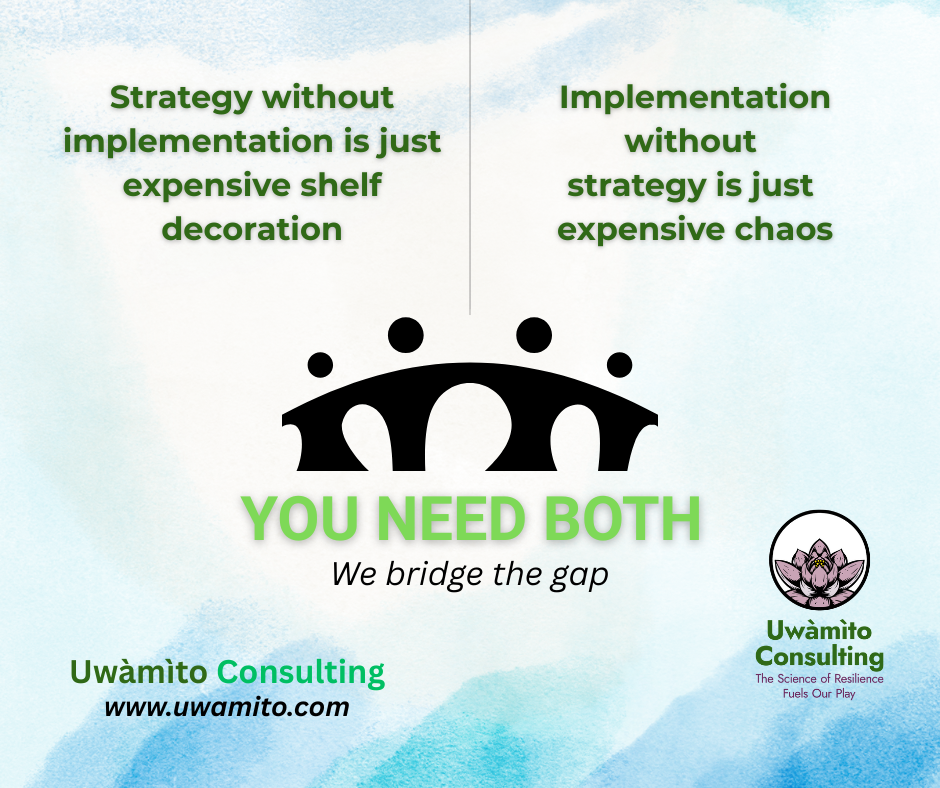
The graphic we created illustrates this reality simply. Strategy without implementation becomes expensive shelf decoration. Implementation without strategy becomes expensive chaos. You need both, and you need the expertise to bridge them. Uwàmìto Consulting offers Caribbean governments and development organizations what they actually require: consultants who combine deep technical expertise with practical implementation capacity. We do not deliver reports and disappear. We embed systems, train teams, establish coordination mechanisms, and ensure that strategic investments generate measurable results. When you engage Uwàmìto, you partner with consultants who have managed HIV prevention programs reaching 5,000+ people, reviewed national suicide surveillance systems adopted by Ministries of Health, and built strategic frameworks that organizations use daily for fundraising and program development. Our track record demonstrates what becomes possible when strategy and implementation function as integrated disciplines rather than separate activities. This is how development consulting should work. This is how Caribbean organizations can finally close the strategy-implementation gap.

Ready to close your strategy-implementation gap? Contact Uwàmìto Consulting for a confidential consultation. We begin with a Resilience Audit to identify your organization's specific implementation barriers, then design integrated solutions that deliver measurable results. Visit www.uwamito.com or email melliot@uwamito.com to start the conversation. You can call or WhatsApp: 1.868.756.9981

Refrences:

Cândido, C. J. F., & Santos, S. P. (2019). Implementation obstacles and strategy implementation failure. Baltic Journal of Management, 14(1), 39-57. https://doi.org/10.1108/BJM-11-2017-0350

Carucci, R. (2017, November 13). Executives fail to execute strategy because they're too internally focused. Harvard Business Review. https://hbr.org/2017/11/executives-fail-to-execute-strategy-because-theyre-too-internally-focused

Girma, B. G. (2022). Pitfalls on strategy execution of an organization: A literature review. Financial Metrics in Business, 3(2), 227-237. https://doi.org/10.25082/FMB.2022.02.004

Mwanza, M., et al. (2025). The role of strategy implementation practices on performance of the public sector organisations. Africa's Public Service Delivery & Performance Review, 13(1). https://doi.org/10.4102/apsdpr.v13i1.891

Vigfússon, K., Jóhannsdóttir, L., & Ólafsson, S. (2021). Obstacles to strategy implementation and success factors: A review of empirical literature. Strategic Management, 26(2), 12-30. https://doi.org/10.5937/StraMan2102012V


The girl and the shoemaker: My first example of implementation.

My choice for assimilating new information will always be reading it from a script or seeing someone deft with their hands/ or have a skill, complete a task. To me, there is something magical to someone who can bring an idea to life.

My thoughts go back to some of the more fond memories of my childhood when I sat in silence with my paternal grandfather for hours. Nathaniel Jackson, whose nickname was ‘boomtown’ got the name during his younger years due to his ability to face anyone in a physical fight. He would often take it upon himself to serve justice to wife beaters especially, from the stories shared. I only saw him irritated once or twice but never angry . I never saw him angry ever.

Some of the other things I recalled of him was his love for the strongest coffee which he loved super hot, bitter and in small portions. Probably explains why I love coffee so much. He would often inhale the spirit of ammonia not sure why. He played the harmonica or ‘mouth organ’. He was a very tall, handsome man and when he left home to ‘go out the road’ as he would say, he was always well-dressed (felt hats and the best pair of shoes). Brace yourself on a Friday evening since he often returned intoxicated. Still, he was a ‘happy drunk’, much to the dismay of my dad and uncle who did not like seeing their daddy in that condition it seems. But I enjoyed listening to him even then since everything made sense, it was almost poetic. He would often repeat ‘I will never die and leave you ignorant of the facts’ even then I could never go to sleep knowing he was up. He could have easily been my favourite human being at the time.

He was better known as the village ‘shoemaker’ or cobbler, a descendant of the ‘merikins’. By now you can probably guess which part of the Trinidad he was from (St. Julien Village, Princes Town). I would often sit for hours with him as he always did a monologue while he repaired a shoe or built a pair of shoes from scratch. I think as I got older, the monologue changed to dialogue, but whenever he was repairing a shoe, he became enrapt in what he was doing. He would take a break, and in those moments, he would speak. I am sure when I started sitting on the special bench, he made for me to look at him while he worked, I was unable to speak then I think. I sat there for long hours, he did talk to me, and I understood every word. He used to call me ‘little old lady’.

He had a way with this very sharp knife, he had other tools (there was a piece called a ‘blakie’, and there were pairs of wooden feet he often used to replace the shoe sole to name a few) as well. I loved the way he manoeuvred wax, thread and a needle to sew a delicate area of a side of shoe gone bad. Villagers would often come to him to fix one side of shoe although the pair needed fixing. He would often explain that both sides needed fixing since it would save them a ‘little change’ (meaning money). He would always fix both sides.

He paid attention to the fine details, I often wondered why he placed both the detached sole and the shoe in the sun with a coating of ‘contact cement’ for such a long time. He said to make sure it lasts. He would take his time to stick them together and would use a flat-faced hammer. It did not end there as he would then use the wax, thread and needle and sew it together. In my mind, I did not think all those actions were necessary. Still, reflecting now, I understood why he believed in doing quality work and had his system of quality assurance. Everybody brought their shoes for him to fix, they would also bring new pairs of shoes for him to resole and sew.

I remember there was also a parang band I think that emanated from my grandmother as her family were Spanish descent, but he played the ‘box bass’ and always had his mouth organ in his back pocket.

He made me a pair of sneakers once, he felt proud of himself. I remember he got the unique leatherette in both colours of light green and silver. I am not sure where he got the prototype from, but that pair of shoes easily weighed around 8 to 10 pounds. It was heavvvvy. I remember having speed after taking off the shoes before running a race and winning.

I remember when we moved to Ecclesville, and I had to go to primary school, I saw less of him. I would often go back to St. Julien for the August vacation, and then it was my turn to share my stories with him. That place always gives me a special nudging as there were all kinds of fruit trees on his land, my favourite trees were the mango trees, the wild cherry tree called ‘lay-lay’ and the lucky tree. He kept his garden in top condition - there was ginger, ‘topi-tambu’ a fragrant tasting root almost the size and shape of larger cherries. There were a fresh-water spring and a pond on the land - I remember drinking the water from the spring, they often used the water to cook and wash.

I was not the talkative type, I was an observer, so he encouraged me to share my thoughts with him, what my thoughts were about things. I think he knew I did not like talking much; I was more of a thinker. I remember him telling me that I must try to read, and would often give me a book to write things he wrote before. His handwriting was also impeccable.

I remember writing the common entrance exam, I had an excellent primary school experience. In essence, I did everything; I participated in every kind of sports, I recited poems, I sang in the choir. I also sang solos, I had a knack for writing stories. I was also an entrepreneur (smile) as I sold all kinds of chow and saved money in the junior cooperative. I remember that graduation getting a lot of prizes, got a few trophies and some books. I had to spend many lunchtimes getting coached to deliver the valedictory speech. I was happy to make the journey to visit my grandfather to tell him about this. He wanted every detail, and I remember how glad he was as it was my turn to make him laugh. I was happy to see him, and he did say that he was proud of me. He asked me about this school I passed for, I told him I did not know the school existed, in fact, the first time I heard the name of the school was when the teachers announced the results.

That August that decision was made for me to stay in Ecclesville as items had to be prepared for the new school and the new school term. The arrangements were made for me to stay with my grandparents once school was opened. The school was located in Moruga which was not very far from St. Julien much closer than Rio Claro. I did not mind not spending time with him that August because I knew I was going to see him a whole lot. Life is strange during that period he stopped drinking alcohol I heard. He fell ill, went to the hospital and never returned home. That August, my grandfather died. I remember the wake, and I listened to the stories people shared about him. I remembered seeing him in the coffin but not being able to go to the cemetery or the church. That August I read my first novel ‘Heidi’ it was a prize I won for one of the subject areas. That book resonated with me as it was the story of a girl and her grandfather. I did not have a human being around who was as wise as him then. So I started to read, I used books to not only escape but to find the answers I was looking for. As I reflect, a number of my profound internal pivots were followed after reading books. I have read hundreds of books over my lifetime, but a few stand out, including:

  1. Heidi - Johanna Spyri

  2. Bring out the magic of your mind - Al Koran

  3. Sherlock Holmes - Arthur Conan Doyle

  4. Answer as a man - Catherine Cookson

  5. Tapping the power within: A path to self-empowerment for black women - Iyanla Vanzant

  6. The Alchemist - Paolo Coelho

  7. Can’t hurt me: Master your mind and defy the odds - David Goggins

  8. Beyond the Boundary - CLR James.

My grandfather is my favourite ancestor. I think from him I learnt about implementation and doing things with a system which should be adhered to even when no one was looking. It was strange that his objective was not satisfying the customer but rather the joy and fulfilment he got from doing what he loved. He spared nothing in getting the quality products and resources needed to complete the job. He had a system for people who owed him and collecting money. In essence, I received the payments sometimes, and he would instruct on the amount of change to give the person. Sometimes the person really could not pay, and he never was harsh but told them to remember him whenever they got the money.

My grandfather was interesting to me as he was the first example of a perfectionist.